
Articles
The Best Study Methods for Passing Difficult Exams
Science ranks retrieval practice 43% more effective than re-reading. Discover the 7 best study methods for certification exams, with research data, comparison tables, and a step-by-step implementation guide.

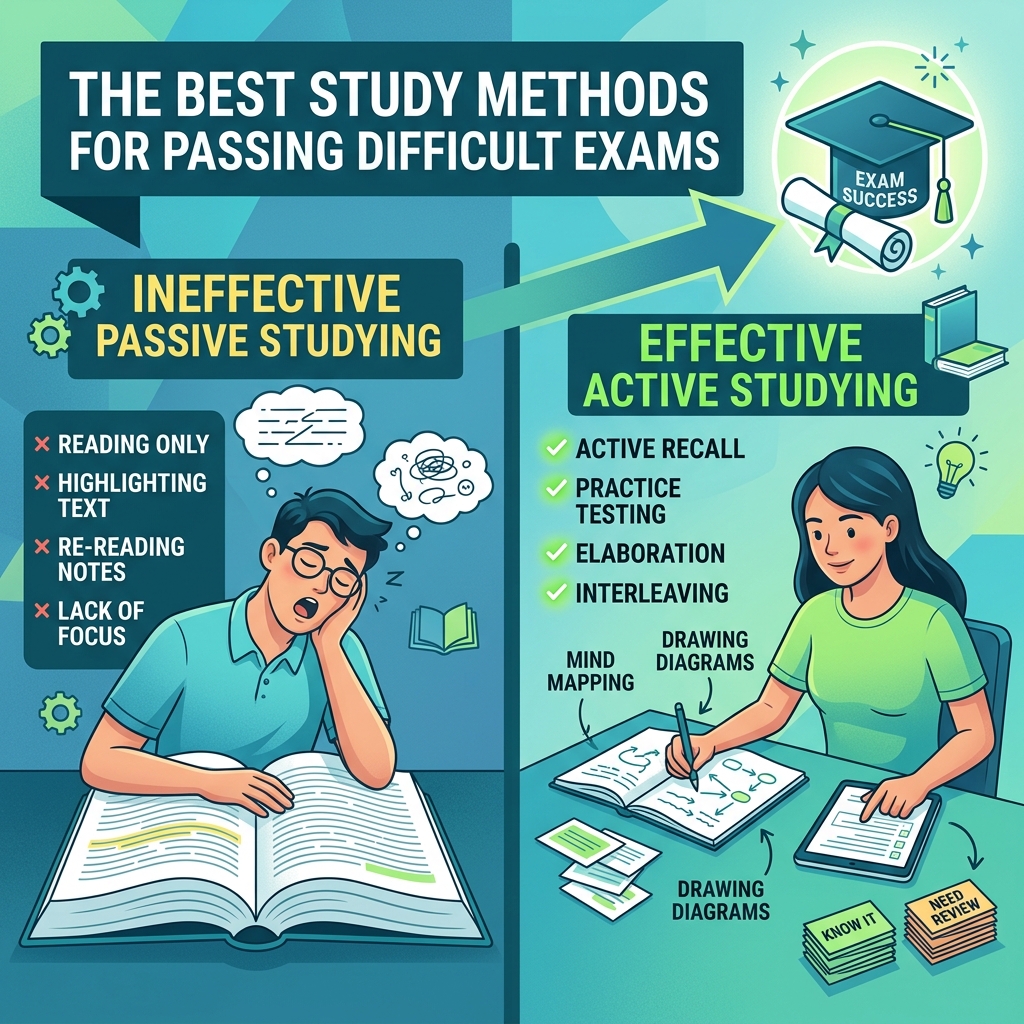
Most people study the way they were taught in school – read the chapter, highlight the important parts, maybe write out some notes. The problem is that decades of cognitive science research consistently shows this approach is one of the least effective ways to retain information for high-stakes exams. The gap between how people naturally tend to study and how they should study is large enough to be the primary reason many candidates fail on their first attempt.
This guide covers the seven study methods with the strongest evidence base, explains the science behind why each one works, and gives you a practical implementation framework you can apply immediately to your certification prep.
Passive vs. Active Study: Understanding the Core Problem
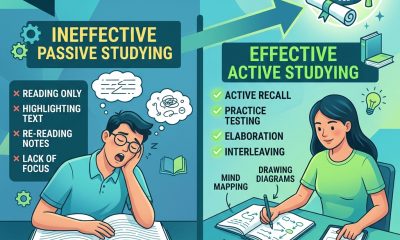
The single most important distinction in study methodology is the difference between passive and active learning. Passive study involves receiving information – reading, watching, listening, highlighting. Active study involves producing information – recalling, explaining, applying, testing. Research published in Psychological Science in the Public Interest by Dunlosky et al. (2013) evaluated 10 common study techniques across 700 studies and rated them by effectiveness:
| Study Technique | Evidence Rating | Why It Works (or Does Not) |
|---|---|---|
| Practice Testing (Retrieval Practice) | ⭐ HIGH utility | Forces memory recall; directly mirrors exam conditions; improves long-term retention by 50%+ |
| Distributed Practice (Spaced Repetition) | ⭐ HIGH utility | Exploits memory consolidation during rest; reduces total study time by 20–40% |
| Elaborative Interrogation | MODERATE utility | Asking “why” deepens understanding; works best with factual material |
| Self-Explanation | MODERATE utility | Explaining concepts in your own words reveals knowledge gaps |
| Interleaved Practice | MODERATE utility | Mixing topics during study sessions improves discrimination and application |
| Re-reading | LOW utility | Creates illusion of familiarity; does not strengthen memory retrieval pathways |
| Highlighting / Underlining | LOW utility | Passive; selects information but does not process it; widely overused |
| Summarization | LOW utility | Can help if done actively; minimal benefit if just condensing text |
| Keyword Mnemonics | LOW utility | Helps with vocabulary memorization; poor for conceptual understanding |
| Imagery Use for Text Learning | LOW utility | Dependent on vividness of material; difficult to apply systematically |
This research has been replicated consistently for over 30 years. The gap between high-utility and low-utility techniques is not marginal – it is substantial enough to determine pass or fail outcomes on certification exams.
Method 1: Retrieval Practice (The Most Powerful Study Tool Available)
Retrieval practice – also called the testing effect – is the act of pulling information out of memory rather than reviewing it passively. Every time you attempt to recall information, you strengthen the neural pathway that retrieves that information. Every time you re-read the same material, you primarily reinforce the sensation of familiarity, which does not translate to actual recall on exam day.
The most famous study on this was conducted by Karpicke and Roediger (2008) at Purdue University. Students who used retrieval practice (answering questions from memory) scored an average of 50% higher on delayed tests than students who used re-reading. This effect held even when students felt more confident after re-reading.
How to implement retrieval practice for certification prep:
Are you ready for the interview?
Practice interview questions in a real interview-style setting.
- Start doing practice questions from Day 1 of your prep, before you feel ready. Getting questions wrong early is the mechanism of learning – not a sign you are not ready to study yet.
- After every study session, close your materials and write down everything you remember from the session without looking. This is called a “brain dump” and is one of the most efficient free recall exercises available.
- Use flashcards in retrieval mode: look at the front, actively recall the answer before flipping. Never just read the front and back together passively.
- When you get a practice question wrong, write the correct concept in your own words immediately. This converts the wrong answer into a learning event rather than just a score deduction.
You can practice under realistic timed conditions using InterviewForge’s free mock exam simulator, which gives you the exam pressure environment that makes retrieval practice most effective.
Method 2: Spaced Repetition (Study Less, Remember More)
Spaced repetition exploits a fundamental feature of human memory: information that is reviewed at increasing intervals over time is retained far longer than information reviewed in large blocks. This is the opposite of cramming, which clusters all review into a single intensive session and produces retention that degrades rapidly after the exam.
The optimal spacing intervals for long-term retention, based on Ebbinghaus curve research, are approximately: 1 day, 3 days, 1 week, 2 weeks, 1 month. Software like Anki automates these intervals, showing you each flashcard at the precise moment before you would forget it. This makes it possible to retain thousands of concepts with a fraction of the review time that traditional methods require.
For a complete guide to implementing this technique, read our article on spaced repetition explained for exam preparation.
Method 3: Active Recall With Elaboration (The “Why” Technique)
Certification exams test application, not definition recall. This means knowing a concept is necessary but not sufficient – you also need to know why it works the way it does, when it applies versus alternatives, and what it looks like in a real scenario. This is where elaborative interrogation and self-explanation become powerful supplements to retrieval practice.
For every concept you study, ask yourself these four questions:
- What is this? (Definition – the starting point, not the endpoint)
- Why does it work this way? (Mechanism – understanding the underlying logic)
- When would I use this vs. a similar alternative? (Discrimination – critical for multiple choice)
- What does this look like in practice? (Application – the clinical or real-world scenario)
Answering all four questions forces you to construct a full conceptual model rather than a surface-level definition. Exam questions that seem ambiguous to underprepared candidates become straightforward to those who have built this depth of understanding.
Method 4: Interleaved Practice (Mixing Topics During Study)
Most candidates study one topic at a time – blocking – moving to the next only when the first feels mastered. This feels organized and efficient but creates a specific problem on exam day: questions from different domains are interleaved randomly, and the brain must discriminate between similar concepts without the contextual cue of “I am currently in the reinforcement section.”
Free ATS Resume Maker & Analyzer
Create a resume that passes ATS checks and impresses recruiters in seconds.
Interleaved practice – deliberately mixing questions from different topics during study sessions – trains this discrimination ability directly. A landmark study by Kornell and Bjork (2008) found that interleaved practice produced 43% better performance on a final test compared to blocked practice, even though students felt less confident during interleaved sessions (because the difficulty was higher in the moment).
| Study Session Type | How It Feels During Study | Actual Exam Performance | Best Used |
|---|---|---|---|
| Blocked Practice (one topic at a time) | Easy, feels productive, builds confidence | Moderate – performance drops when topics are mixed on exam | First exposure to brand new material only |
| Interleaved Practice (mixed topics) | Harder, feels less efficient, more mentally taxing | High – 43% better on mixed-format tests (Kornell & Bjork) | Weeks 3 onwards after initial exposure |
| Full Mixed Practice Exams | Realistic exam pressure; most accurate readiness indicator | Highest – best simulation of actual exam conditions | Final 2–3 weeks before exam |
Method 5: The Feynman Technique (Teach It to Know It)
The Feynman Technique, named after Nobel Prize-winning physicist Richard Feynman, is one of the most effective tools for identifying and closing knowledge gaps. The process is straightforward:
- Choose a concept you have just studied.
- Explain it out loud or in writing as if you are teaching it to someone with no background in the subject – using simple language, no jargon.
- Identify every point where your explanation breaks down, becomes unclear, or requires you to look something up. These gaps are your actual knowledge gaps.
- Return to the source material, fill the gap, then attempt the explanation again.
Most candidates can recite definitions but cannot explain the underlying concepts in plain language – and certification exams are specifically designed to expose this weakness. The Feynman Technique fixes it systematically. A single 15-minute session explaining one concept without notes will reveal more gaps than an hour of re-reading.
Method 6: Wrong-Answer Analysis (Turning Mistakes Into Mastery)
Most candidates look at which practice questions they got wrong, note the correct answer, and move on. This is leaving the majority of the learning value of each wrong answer on the table. A wrong answer – analyzed properly – is more valuable than a correct one, because it reveals a specific, actionable gap in your knowledge or exam strategy.
The full wrong-answer analysis protocol:
| Step | What to Do | Why It Matters |
|---|---|---|
| 1. Categorize the error | Was it a knowledge gap, a misread question, an elimination error, or a time-pressure mistake? | Different error types require different fixes; treating all wrong answers the same wastes time |
| 2. Identify the concept tested | Name the exact task list item or domain concept the question was testing | Maps the gap to the content outline; allows targeted review |
| 3. Understand the correct answer | Why is the correct answer correct – specifically, not just “because the answer key says so” | Prevents repeating the same error on similar questions |
| 4. Understand why you chose wrong | What made your answer seem correct? What would need to be different for it to be right? | Prevents the distractor from fooling you again |
| 5. Write it in your own words | Explain the correct concept in 2–3 sentences without looking at the answer | Confirms genuine understanding, not just surface agreement |
| 6. Schedule a review | Add the concept to your spaced repetition deck or weak-area review list | Ensures the learning from the error is consolidated and not forgotten |
For more on specific active recall strategies, see our guide on best active recall techniques for studying.
Method 7: Full-Length Timed Practice Exams Under Realistic Conditions
Everything else on this list builds your knowledge base. For domain-specific study on RBT content, our guide on RBT data collection methods applies these active recall techniques directly. This method is what converts knowledge into exam performance. A full-length timed practice exam done under realistic conditions – desk, timer, no interruptions, no references – does several things simultaneously that no other study method replicates:
- Builds exam stamina. Sitting focused for 90 minutes or longer is a physical and cognitive skill that requires practice. Candidates who have never done this before exam day are at a significant disadvantage.
- Calibrates your pacing instincts. You learn which question types take 30 seconds and which take 90 seconds, which allows you to develop automatic time allocation without conscious calculation.
- Reveals integration gaps. Knowing concepts in isolation is different from applying them when surrounded by similar concepts in a timed, high-pressure environment. Practice exams expose integration failures that domain-specific review misses.
- Provides accurate readiness scores. Your score on a full timed practice exam – not your confidence level – is the most reliable indicator of whether you are ready to sit for the real exam.
Most exam coaches recommend completing at least 3–5 full-length timed practice exams in the final 2–3 weeks of preparation. Anything fewer does not provide enough data to confirm readiness or identify remaining gaps.
Building Your Personal Study Method Stack
These seven methods are not mutually exclusive – the most effective candidates use all of them in a structured sequence based on where they are in their preparation timeline:
| Prep Phase | Primary Methods | Secondary Methods | Avoid or Minimize |
|---|---|---|---|
| Weeks 1–2 (Foundation) | Retrieval practice (domain-specific Qs), Feynman Technique | Elaborative interrogation, spaced repetition setup | Full-length timed exams, interleaving (too early) |
| Weeks 3–5 (Building) | Interleaved practice, wrong-answer analysis, spaced repetition | Retrieval practice, Feynman on weak areas | Re-reading covered material, passive review |
| Weeks 6–7 (Consolidation) | Full-length timed practice exams, intensive wrong-answer analysis | Spaced repetition of weak items, interleaved sets | Introducing new material, changing study methods |
| Final Week | Light spaced repetition of weak-area list only | One timed exam (Day 3 before exam only) | Cramming, new material, intensive sessions |
Frequently Asked Questions
What is the single most effective study method for certification exams?
Retrieval practice – answering questions from memory without looking at notes – has the strongest evidence base of any study technique for certification exam preparation. Research shows it produces 50% better long-term retention than re-reading the same material. Combined with thorough wrong-answer analysis, it is the most efficient use of study time available.
Is highlighting or underlining a good study method?
No – highlighting and underlining are rated as LOW utility by the most comprehensive review of study technique research (Dunlosky et al., 2013). They create an illusion of engagement without requiring your brain to actually process or retrieve the information. If you want to mark important content, do it during active reading sessions, then immediately use retrieval practice on those marked items rather than re-reading the highlighting later.
How should I split my study time between reading and practice questions?
For certification exam preparation, the optimal split is approximately 30–40% content review and 60–70% active practice (retrieval practice, practice questions, timed exams). Most candidates get this backwards – they spend 80% reading and 20% on practice questions. Shifting toward active methods is the single most impactful change most candidates can make to their study routine.
Does the Feynman Technique work for all types of certification exams?
Yes, though it is most powerful for conceptually dense material where understanding the “why” behind procedures is important – such as ABA exams (RBT, BCBA), nursing licensure (NCLEX), and project management certifications (PMP). It is somewhat less applicable to pure fact-memorization exams, though even there it helps with accuracy and retention of related concepts.
The Bottom Line
The research is unambiguous: the study methods that feel most comfortable – re-reading, highlighting, summarizing – are consistently the least effective. The methods that feel harder in the moment – retrieval practice, interleaving, wrong-answer analysis – produce dramatically better exam outcomes. This phenomenon is called “desirable difficulty,” and it is the core principle behind evidence-based studying.
Switching to high-utility methods is uncomfortable at first because the difficulty signals genuine learning – your brain working to retrieve, discriminate, and apply, rather than simply recognize familiar text. That discomfort is not a sign you are studying poorly. It is a sign you are studying right. Lean into it, and your exam performance will reflect the difference.

The 4 Functions of Behavior in ABA: A Complete Guide
Master the 4 functions of behavior (SEAT) with the complete ABA guide: definitions, clinical examples, function-based treatment table, functional assessment...

How to Renew Your RBT Certification: Step-by-Step Guide
Step-by-step RBT renewal guide: 4 required components, 90-day timeline, competency assessment requirements, what happens if your credential lapses, and year-round...


What to Do the Day Before and Day of Your Certification Exam
Day-by-day framework for the week before your exam, a specific night-before protocol, hour-by-hour exam morning guide, and in-exam tactics. Research-backed...


RBT Data Collection Methods: A Complete Guide
Complete guide to RBT data collection: continuous vs. discontinuous measurement, all 8 recording methods with tables, new 3rd Edition calculation...


ABA Therapy Techniques Every RBT Should Know
Complete guide to core ABA therapy techniques for RBTs: reinforcement types, DTT, NET, prompting hierarchies, chaining, differential reinforcement, and extinction....


RBT Supervision Requirements: Everything You Need to Know
Complete guide to RBT supervision requirements: the 5% monthly minimum, what qualifies as supervision, documentation standards, annual renewal, and what...

RBT vs. BCBA: What Is the Difference and Which Career Is Right for You?
RBT vs. BCBA: compare education requirements, salary data, scope of practice, and career timelines side by side. Includes 5 comparison...


RBT Practice Questions: How to Use Them Effectively
Research shows practice testing beats all other study methods by 43%. Learn how to use RBT practice questions with a...

The Best Study Methods for Passing Difficult Exams
Science ranks retrieval practice 43% more effective than re-reading. Discover the 7 best study methods for certification exams, with research...


How Long Should You Study for a Certification Exam?
How long should you study for a certification exam? Use our 3-step calculation framework, reference table of 8 certifications, Ebbinghaus...


Most Common Mistakes Students Make on Certification Exams (And How to Avoid Them)
Research shows 57% of answer changes go from correct to wrong. Discover the 10 most damaging certification exam mistakes —...

How to Pass the RBT Exam on Your First Attempt (Complete 2026 Guide)
The RBT exam has a ~68% first-attempt pass rate. Learn the exact 8-week study plan, domain breakdown with weighted tables,...

Top 10 Interview Questions For A Team Leaders
In order to increase your chances of landing a position as a team leader, it is essential to demonstrate your...

Interview Question For A Learning Support Assistant
Fear about possible questions for interviews are normal if you’re seeking a job as a learning support teacher. Remember that...

Top 10 Common Questions Asked In Sainsbury’s Interview
Everything you need to know about Sainsbury’s interview questions is right here. 10 most important question that might asked throughout...

10 Common Questions For Sen Teaching Assistant
When applying for a special needs teaching assistant position, demonstrate the hiring manager that you have the skills and compassion...

15 Questions Samples To Ask At End Of Teaching Assistant Interview
Here are some questions samples, you should ask the interviewer at the end of the teaching assistant interview. 15 Questions...

Interview Questions And Answers For Sales Associates
Your sales associate interview is a chance to sell yourself to the recruiting manager by discussing and demonstrating your interests,...

How To Write A Cover Letter In An Attractive Way?
Attaching a cover letter to your CV is a one-page document that serves the purpose of introducing you to a...

Interview Tips For A Supervisor Job
The interview questions you face for a management or supervisory role could differ from those you face for other positions....

What Are Competency Based Questions? The Ultimate Guide
A competency-based interview will focus on testing your knowledge, abilities, and character traits as they pertain to the position for...

Top 25 Tesco Interview Questions And Answers: Ultimate Preparation Guide
Preparing for a job interview can be a nerve-wracking experience, especially when it comes to a reputable company like Tesco....

10 Best Questions Samples For A Phone Interview
To ensure the applicants they promote to the hiring manager fit their criteria, recruiters typically employ phone interviews as a...

Top Interview Questions & Answers For Care Assistant
You may be wondering how to improve your chances of being hired if you are a personal care professional who...

Sample Interview Questions & Answers For Customer Service
If you’re interested in applying for a career in customer service, it’s important to prepare for your interview. This may...

Top 10 Interview Question For Boots
Boots is a successful pharmacy-led health and beauty business well-known for its dedication to providing excellent customer service and high-quality goods....

10 Common Safeguarding Interview Questions For Teaching Assistant.
You will be questioned on a range of issues when you attend an interview for the teaching assistant position. You...

Top 13 Excel Interview Questions & Answers
The most used spreadsheet program is Microsoft Excel. Every expert working in a big or medium-sized business nowadays uses this...

How To Answer The Question: What Do You Know About Aldi?
When you are getting ready for an interview at Aldi, it is essential to be prepared for certain questions that...

10 Best Answers For “Why Should We Hire You?
No matter the industry or position you’re seeking, some types of questions are sure to come up during a job...

16 Most Important Interview Questions For Teacher
Preparing for a job interview in the field of education? You may feel a mixture of excitement and anxiety. The...

Top 11 Retail Assistant Interview Questions
An interview provides you with the chance to showcase your abilities, personality, and work ethic to a potential employer while...

Top 10 Administration Assistant Interview Questions
Administrative professionals are in high demand. Using these abilities has actually been one of the five most sought-after job categories...

Top 10 Morrison’s Interview Questions And Answers
The supermarket chain Morrisons is one of the most successful in the UK and is well-known for its dedication to...

What Makes A Good Sen Teaching Assistant?
Students who have difficulty learning are provided with extra learning opportunities by a special educational needs (SEN) teaching assistant, who...

Best Answers To “Where Do You See Yourself As A Teacher In 5 Years?”
When you decide to pursue a career in education, you are not just making a professional decision; you are committing...

Top 10 Safeguarding Interview Questions For Support Workers
Those who serve as support workers are vital in ensuring that at-risk youth, families, and the elderly can live fulfilling,...

10 Common Interview Questions For McDonald’s
If you work for the most profitable business in history, flipping burgers is definitely not a dirty job. Fast food...

10 Important Interview Questions For Eyfs Teaching Assistant
Proven strategies and insightful responses to 11 key questions for seamless integration into the world of play-based learning and individualized....

10 Common Questions And Answers For Childcare Interview
Working with kids is satisfying and hard. Before you can teach your kids, you must pass the recruiting procedure, which...

Tips To Answering Behavioral Interview Questions
Interviewers can ask about your prior actions and reactions to certain scenarios to get a feel for how you might...

Best Personal Statement Samples For Civil Service Job
An accompanying personal statement may be necessary when applying for a position in the public sector. You may learn more...

Top 10 Common Safeguarding Interview Questions Of Staff
Many industries prioritize safeguarding, notably those that care for staff, the elderly, and the disabled. This field requires professionals who...

Top 10 Interview Tips For Teacher
When you are applying for jobs at a variety of educational institutions, the interview that you have with the potential...

Top 15 Reasons To Leave A Job
Leaving one’s work was not only unusual but also considered to be something of a social faux pas. Why, after...


How Does an Assistant for Lawyers Get Hired by a Law Firm?
The many career opportunities offered by law make this profession one of the most sought-after and popular in the worldwide...


How to Conduct a SWOT Analysis for Career Growth
Introduction A SWOT analysis is a simple cut powerful tool that helps to understand these strengths, weaknesses, opportunities and threats...


How to Stay Motivated During Long Job Searches
Introduction The most challenging and frustrating process is looking for a job especially when it takes longer than expected to...


How to Handle Situational Questions Effectively
Introduction Situational questions refer to tests that are taken to test the ability of a candidate to think critically, solve...


Tips for Researching Hiring Managers on LinkedIn
Introduction In today’s competitive and advanced top market it is important to know about how to reset hiring managers on...


The Role of Job Shadowing in Interview Prep
Introduction Job interviews can be extremely stressful especially when someone is entering a new field or applying for a job...


How to Create a Job Application Tracker
Introduction It can be stressful to look for a job especially when someone wants to apply in multiple positions. By...


Top Courses for Enhancing Remote Work Skills
Introduction Remote works are now considered as a major part of today’s professional world. They provide people with flexible schedules,...


How to Master Professional Email Writing Through Online Classes
Introduction In today’s digital and fast paced world, professional email writing is considered as an important skill. If someone is...


Certifications in Workplace Diversity and Inclusion
Introduction In today’s fast paced and digital world there are work places that are becoming more diverse than they ever...


Top Programs for Building Financial Literacy Skills
Introduction Financial literacy is an important life skill that helps the individuals to manage their money and to make informed...


Certifications for Advanced Team Collaboration Skills
Introduction It is important to have teamwork in today’s workplace because it has to build the companies. There are companies...


Tips for Reviewing Company Financials Before Interviews
Introduction When we candidates are preparing for the job interview they only focus on their resume, possible interview questions and...

How to Build a STAR Story Bank for Interviews
Introduction Job interviews can be quite stressful to manage especially when the employers ask behaviour in questions like tell me...


How to Use Nonverbal Cues Effectively During Interviews
Introduction Interviews are considered as an opportunity to present yourself in front of the employers. They are not only about...

Ultimate Guidance: How To Give A Great Job Interview Presentation?
During an interview, you can be requested to deliver a presentation on a subject that is pertinent to the position....

How To Write A Job Application Letter Efficiently?
At the same time that the world is becoming a better place, competition for jobs is heating up. Finding a...

Top 10 Ways To Make A Great LinkedIn Profile
You should have an interesting LinkedIn profile at every point in your job hunt. LinkedIn is easily the biggest professional...

Top 10 Questions And Answers For A SQL Interview
The following is a list of the most prominent and helpful SQL interview questions and answers for applicants who are...

Top Teaching Assistance Online Courses
Could you see yourself working as an assistant in a classroom? The importance of teaching assistants has increased significantly in...

Is Being A Teaching Assistant Worth It?
Teaching assistants (TAs) play a vital role in the ever-changing field of education. They assist teachers significantly and substantially contribute to...

Top 5 Online Courses For Excel
FOAt the most basic level, Microsoft Excel is a spreadsheet tool used to gather, analyse, and display qualitative and quantitative...

Top Reasons Why Safeguarding Is Important
If your company does business with or is otherwise frequently connected to children and/or people who are vulnerable, one of...

How To Become A Teaching Assistant?
Do you want to become a teaching assistant but don’t know where to begin? A teaching assistant in the classroom...

Most Common Questions To Ask At End Of Teaching Assistant Interview
The secret to acing an interview is preparation, which includes studying up on the organization and the most typical questions...

Top Training Courses For A Sen Teaching Assistant
The key problem with effectively supporting students with Special Educational Needs (SEN) in educational settings is one that the SEN...

How to Answer “Why Do You Want To Be A Teacher?”
Employers may use this question to determine whether or not you are a committed teaching professional by making use of...

What Makes A Good Teaching Assistant?
A classroom doesn’t work without a teaching assistant. By ensuring that every student has access to the resources they need...

Top 15 Interview Questions For Nursery Assistant
You may be well-prepared for the interview by reading the questions ahead of time, but your greatest chance of landing...


Is It Possible To Become A Teacher Assistant Without Any Experience?
When working in an educational environment, teaching assistants and aids collaborate with the primary instructors. In addition to providing assistance...

Which Skills Are Needed To Work In The Nursery?
Beginning a career at a nursery may be quite satisfying since it provides the opportunity to directly influence the early...

Top 15 Qualities Of A Good Teacher
The most effective teachers, whether they work in traditional Classroom settings or online, have a set of traits that make...


Why It’s Important to Modernize Your Skills and Keep Up With New Health Tech?
Healthcare is evolving at an unprecedented pace, driven by technological advancements and innovative treatment methods. For professionals in the medical...


Clean Audit: Building a Culture of Year-Round Compliance
For many organizations, the annual audit feels like a high-stakes event that demands intense preparation in a short window of...


Marketing Playbook: Evergreen Tactics That Actually Drive ROI
Marketing trends come and go, but some strategies consistently deliver results regardless of industry shifts. These evergreen tactics form the...
-

 Interview Preps2 years ago
20 Caregiver Interview Questions And Answers
-
 Interview Preps1 year ago
Why Should We Hire You As A Teacher? Practical Answers
-

 Interview Preps1 year ago
Top 35 Must Know Greggs Interview Questions & Expert Answers!
-
 Interview Preps1 year ago
The Most Common Questions For Aldi Video Interview
-
Interview Preps2 months ago
What Are Competency Based Questions? The Ultimate Guide