
Articles
How to Pass the RBT Exam on Your First Attempt (Complete 2026 Guide)
The RBT exam has a ~68% first-attempt pass rate. Learn the exact 8-week study plan, domain breakdown with weighted tables, application-level question strategies, and exam day tactics used by successful candidates.

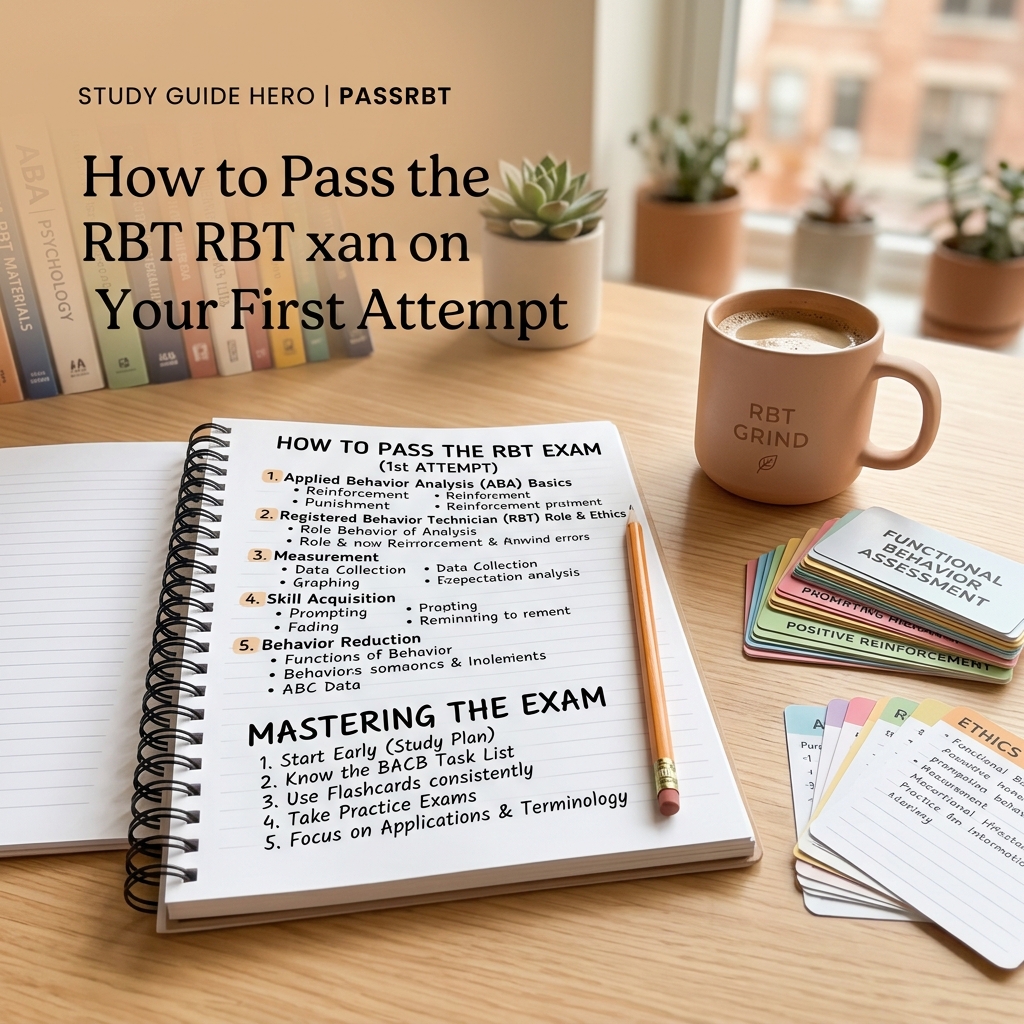
The Registered Behavior Technician (RBT) exam has a national first-attempt pass rate hovering around 68% — meaning nearly one in three test-takers fails the first time. That statistic is not a reflection of intelligence. It is a reflection of preparation strategy. The candidates who pass consistently are not necessarily smarter; they study differently, more deliberately, and with a clear understanding of what the BACB is actually testing.
This guide breaks down exactly what you need to do week by week, domain by domain, to put yourself in the 68% that pass on their first attempt.
What Is the RBT Exam? Quick Overview
The RBT certification is administered by the Behavior Analyst Certification Board (BACB). It is the entry-level credential for behavior technicians who implement Applied Behavior Analysis (ABA) therapy, most commonly with individuals diagnosed with autism spectrum disorder.
| Exam Detail | Information |
|---|---|
| Total Questions | 85 (75 scored + 10 unscored pilot questions) |
| Time Allowed | 90 minutes |
| Format | Computer-based, multiple choice |
| Passing Score | ~68% (score scale 0–250, passing ~200) |
| Testing Centers | Pearson VUE locations nationwide |
| Retake Policy | Must wait until next calendar month |
| Exam Fee | $45 (as of 2024) |
The 6 RBT Test Content Outline Domains (3rd Edition – Effective January 2026)
The most critical document for RBT exam preparation is the BACB RBT Test Content Outline (3rd Edition), which replaced the previous Task List and became effective for all exams on January 1, 2026. Note: the BACB officially changed the name from “Task List” to “Test Content Outline (TCO).” It now contains 43 tasks (up from 37 in the previous edition), organized across six domains. Every exam question maps to a specific task. Do not study from a generic ABA textbook – study from the TCO directly.
| Domain | Exam Questions | % of Exam | Key Topics |
|---|---|---|---|
|
A – Data Collection & Graphing |
13 questions | 17% | Continuous measurement (frequency, duration, latency, IRT), discontinuous measurement (partial interval, whole interval, MTS), permanent product recording, graphing, data summarization (rate, mean, percentage), identifying trends |
| B – Behavior Assessment | 8 questions | 11% | Preference assessments (multiple stimulus, paired stimulus, free operant), skill assessments, assisting with functional assessment (descriptive assessment, functional analysis, ABC recording) |
| C – Behavior Acquisition | 19 questions | 25% | Positive and negative reinforcement, discrete trial teaching (DTT), naturalistic teaching (NET), task-analyzed chaining (forward, backward, total task), shaping, prompting and fading, discrimination training, token economies, generalization |
| D – Behavior Reduction | 14 questions | 19% | Identifying functions of behavior, antecedent interventions, differential reinforcement (DRO, DRA, DRI, DRL, FCT), extinction, punishment procedures and secondary effects, crisis and emergency procedures |
| E – Documentation & Reporting | 10 questions | 13% | Objective session documentation, seeking supervision, reporting variables that affect client progress, procedural fidelity, data accuracy risks |
| F – Ethics | 11 questions | 15% | Core ethical principles, competence, professional boundaries, gift-giving policies, cultural humility and responsiveness, dual relationships, maintaining BACB ethics standards |
Key insight: Domain C (Behavior Acquisition) is the heaviest at 25% of the exam, accounting for 19 of 75 scored questions. Domain A (Data Collection and Graphing) is now 17%, significantly higher than the old 2nd Edition weighting – making it a critical study priority. If you allocate equal time across all six domains, you are under-investing in the areas most likely to move your score.
> The 8-Week RBT Study Schedule That Works
Most candidates need 6–10 weeks to prepare adequately. Below is a structured 8-week plan that proportionally weights study time to each domain’s exam share. For a deeper dive into scheduling strategies, see our guide on how to create a certification study schedule that works.
| Week | Focus Area | Daily Study Goal | Practice Questions |
|---|---|---|---|
| Week 1 | Domain A: Measurement | 45–60 min review | 20 domain-specific Qs |
| Week 2 | Domain B: Skill Acquisition (Part 1) | 60 min review | 25 domain-specific Qs |
| Week 3 | Domain B: Skill Acquisition (Part 2) | 60 min review | 30 domain-specific Qs |
| Week 4 | Domain C: Behavior Reduction | 45–60 min review | 20 domain-specific Qs |
| Week 5 | Domains D, E, F | 45 min review | 15 per domain |
| Week 6 | Full Review + Weak Spots | 60 min targeted study | 50 mixed Qs |
| Week 7 | Full Practice Exams (Timed) | 2 full-length exams | 85 Qs per session |
| Week 8 | Final Consolidation | 30–45 min light review | 25 weak-area Qs only |
The Right Way to Use Practice Questions
Practice questions are not just a review tool — they are your primary learning engine. Research in cognitive science consistently shows that retrieval practice produces better long-term retention than re-reading or passive review. The act of trying to recall information, even when you fail, strengthens the memory trace more than simply reviewing it again.
Are you ready for the interview?
Practice interview questions in a real interview-style setting.
Here is the evidence-based protocol for using practice questions effectively:
- Start from Day 1 — Do not wait until you feel “ready.” Getting questions wrong in week one is a feature, not a bug.
- Analyze every wrong answer — Write down why you got it wrong and why the correct answer is right. This takes 2 minutes per question and dramatically accelerates learning.
- Track your domain accuracy — Keep a spreadsheet of correct/incorrect by domain. This data tells you where to spend more time.
- Simulate test conditions — At least twice per week, do a 20-question timed set without looking anything up.
You can practice under realistic conditions using InterviewForge’s free mock exam simulator, which replicates timed test pressure.
Understanding Application-Level Questions
The most common failure mode on the RBT exam is misunderstanding the type of question being asked. The BACB does not primarily test whether you can define terms. It tests whether you can apply concepts to real client scenarios.
Here is a concrete example of the difference:
| Knowledge-Level Question | Application-Level Question (What RBT Actually Asks) |
|---|---|
| “What is differential reinforcement of other behavior (DRO)?” | “During a session, a client engages in self-injurious behavior. The RBT delivers a preferred item only when the behavior has not occurred for 5 minutes. This is an example of which procedure?” |
| “What is shaping?” | “A client cannot yet say ‘water.’ The RBT first reinforces any vocalization, then only sounds resembling ‘w,’ then ‘wa,’ then the full word. This is best described as:” |
Notice the difference. The application question requires you to recognize the procedure in action, not recite a definition. This is why studying from scenarios — not just flashcards — is non-negotiable.
The Week Before Your Exam: What to Actually Do
The final week is not for learning new material. It is for consolidating what you already know. Here is the recommended protocol:
- Days 7–4 before: Review your weak-area list. Do targeted practice on your two lowest-scoring domains only.
- Day 3 before: One final timed full-length practice exam. Review every wrong answer.
- Day 2 before: Light review of your notes. No new practice exams. Go to bed on time.
- Day 1 before (night): No studying. Lay out your ID, know your testing center address, and sleep 7–8 hours.
- Exam morning: Eat breakfast. Arrive 20–30 minutes early. Do a 10-question warm-up set if it calms you down, or skip it entirely.
For a complete day-by-day breakdown, read our article on what to do the week before your certification exam.
Exam Day Strategy: Question-by-Question
Ninety minutes for 85 questions gives you just over 63 seconds per question on average. That sounds tight, but most questions take 30–45 seconds for well-prepared candidates. The time pressure comes from overthinking, not from actual shortage. Here is the tactical approach:
- Read the question stem fully before looking at answer choices. Identify what the question is actually asking — what procedure, what ethical principle, what measurement type.
- Identify qualifier words — “most appropriate,” “first,” “always,” “except.” These words determine the correct answer more than the topic itself does.
- Use elimination. If you can eliminate two obviously wrong answers, your odds on the remaining two are 50/50 even without specific knowledge.
- Flag uncertain questions and move on. Do not sit on a question for two minutes. Flag it, continue, and return with fresh eyes.
- Trust your first instinct when returning to flagged questions. Research consistently shows first-choice answers are correct at a higher rate than changed answers.
Common RBT Exam Topics Candidates Struggle With Most
Free ATS Resume Maker & Analyzer
Create a resume that passes ATS checks and impresses recruiters in seconds.
Based on reported exam experiences and BACB task list weighting, here are the specific topics that trip up the most candidates:
| Difficult Topic | Why It Trips People Up | What to Study |
|---|---|---|
| Types of Differential Reinforcement | DRO, DRI, DRA, DRL are easily confused | Study each type with a concrete clinical example |
| Reinforcement Schedules | FR, VR, FI, VI — differences between ratio and interval | Memorize with real-world analogies (paycheck = FR, slot machine = VR) |
| Measurement Procedures | Confusing continuous vs. discontinuous recording types | Draw a decision tree: what type of behavior u2192 what recording method |
| Prompting Hierarchies | Most-to-least vs. least-to-most — knowing when to use each | Practice with scenario questions, not just definitions |
| Professional Conduct | Ethics questions feel subjective but have clear BACB answers | Read the BACB Ethics Code and apply it literally, not intuitively |
Frequently Asked Questions
How hard is the RBT exam?
With proper preparation, most people find the RBT exam manageable. The national first-attempt pass rate is approximately 68%, meaning well-prepared candidates have a strong chance of passing. The difficulty lies not in the complexity of the content but in the application-based question format, which requires deeper understanding than simple memorization.
How long should I study for the RBT exam?
Most candidates need 6–10 weeks of structured preparation. If you are already working in ABA and have practical experience, 6 weeks is usually sufficient. If the content is completely new to you, plan for 8–10 weeks. Rushing preparation to under 4 weeks significantly increases the risk of needing a retake.
What happens if I fail the RBT exam?
If you do not pass, you must wait until the next calendar month to retake the exam. There is no limit on the number of retakes. Use the failure as diagnostic data — the BACB provides score feedback by domain, which tells you exactly where to focus your second-attempt prep.
Can I take the RBT exam without working experience?
No. The BACB requires you to complete 40 hours of supervised practical experience before sitting for the exam. This experience must be verified by a BCBA or BCaBA. The supervision and field hours are not waivable under any circumstances.
Bottom Line: How to Actually Pass on Your First Attempt
Passing the RBT exam on your first attempt comes down to four non-negotiable practices: studying from the task list (not just a generic textbook), using practice questions from day one, focusing proportionally more time on high-weight domains, and understanding content at the application level rather than the definition level.
The candidates who fail are not less capable — they are less strategic. If you follow the 8-week schedule above, track your weak areas, and enter the exam day physically rested and mentally prepared, you are in a very strong position to walk out with a passing score.
Start with the task list. Build the schedule. Do the practice questions. That is the formula.

The 4 Functions of Behavior in ABA: A Complete Guide
Master the 4 functions of behavior (SEAT) with the complete ABA guide: definitions, clinical examples, function-based treatment table, functional assessment...

How to Renew Your RBT Certification: Step-by-Step Guide
Step-by-step RBT renewal guide: 4 required components, 90-day timeline, competency assessment requirements, what happens if your credential lapses, and year-round...


What to Do the Day Before and Day of Your Certification Exam
Day-by-day framework for the week before your exam, a specific night-before protocol, hour-by-hour exam morning guide, and in-exam tactics. Research-backed...


RBT Data Collection Methods: A Complete Guide
Complete guide to RBT data collection: continuous vs. discontinuous measurement, all 8 recording methods with tables, new 3rd Edition calculation...


ABA Therapy Techniques Every RBT Should Know
Complete guide to core ABA therapy techniques for RBTs: reinforcement types, DTT, NET, prompting hierarchies, chaining, differential reinforcement, and extinction....


RBT Supervision Requirements: Everything You Need to Know
Complete guide to RBT supervision requirements: the 5% monthly minimum, what qualifies as supervision, documentation standards, annual renewal, and what...

RBT vs. BCBA: What Is the Difference and Which Career Is Right for You?
RBT vs. BCBA: compare education requirements, salary data, scope of practice, and career timelines side by side. Includes 5 comparison...


RBT Practice Questions: How to Use Them Effectively
Research shows practice testing beats all other study methods by 43%. Learn how to use RBT practice questions with a...

The Best Study Methods for Passing Difficult Exams
Science ranks retrieval practice 43% more effective than re-reading. Discover the 7 best study methods for certification exams, with research...


How Long Should You Study for a Certification Exam?
How long should you study for a certification exam? Use our 3-step calculation framework, reference table of 8 certifications, Ebbinghaus...


Most Common Mistakes Students Make on Certification Exams (And How to Avoid Them)
Research shows 57% of answer changes go from correct to wrong. Discover the 10 most damaging certification exam mistakes —...

How to Pass the RBT Exam on Your First Attempt (Complete 2026 Guide)
The RBT exam has a ~68% first-attempt pass rate. Learn the exact 8-week study plan, domain breakdown with weighted tables,...

Top 10 Interview Questions For A Team Leaders
In order to increase your chances of landing a position as a team leader, it is essential to demonstrate your...

Interview Question For A Learning Support Assistant
Fear about possible questions for interviews are normal if you’re seeking a job as a learning support teacher. Remember that...

Top 10 Common Questions Asked In Sainsbury’s Interview
Everything you need to know about Sainsbury’s interview questions is right here. 10 most important question that might asked throughout...

10 Common Questions For Sen Teaching Assistant
When applying for a special needs teaching assistant position, demonstrate the hiring manager that you have the skills and compassion...

15 Questions Samples To Ask At End Of Teaching Assistant Interview
Here are some questions samples, you should ask the interviewer at the end of the teaching assistant interview. 15 Questions...

Interview Questions And Answers For Sales Associates
Your sales associate interview is a chance to sell yourself to the recruiting manager by discussing and demonstrating your interests,...

How To Write A Cover Letter In An Attractive Way?
Attaching a cover letter to your CV is a one-page document that serves the purpose of introducing you to a...

Interview Tips For A Supervisor Job
The interview questions you face for a management or supervisory role could differ from those you face for other positions....

What Are Competency Based Questions? The Ultimate Guide
A competency-based interview will focus on testing your knowledge, abilities, and character traits as they pertain to the position for...

Top 25 Tesco Interview Questions And Answers: Ultimate Preparation Guide
Preparing for a job interview can be a nerve-wracking experience, especially when it comes to a reputable company like Tesco....

10 Best Questions Samples For A Phone Interview
To ensure the applicants they promote to the hiring manager fit their criteria, recruiters typically employ phone interviews as a...

Top Interview Questions & Answers For Care Assistant
You may be wondering how to improve your chances of being hired if you are a personal care professional who...

Sample Interview Questions & Answers For Customer Service
If you’re interested in applying for a career in customer service, it’s important to prepare for your interview. This may...

Top 10 Interview Question For Boots
Boots is a successful pharmacy-led health and beauty business well-known for its dedication to providing excellent customer service and high-quality goods....

10 Common Safeguarding Interview Questions For Teaching Assistant.
You will be questioned on a range of issues when you attend an interview for the teaching assistant position. You...

Top 13 Excel Interview Questions & Answers
The most used spreadsheet program is Microsoft Excel. Every expert working in a big or medium-sized business nowadays uses this...

How To Answer The Question: What Do You Know About Aldi?
When you are getting ready for an interview at Aldi, it is essential to be prepared for certain questions that...

10 Best Answers For “Why Should We Hire You?
No matter the industry or position you’re seeking, some types of questions are sure to come up during a job...

16 Most Important Interview Questions For Teacher
Preparing for a job interview in the field of education? You may feel a mixture of excitement and anxiety. The...

Top 11 Retail Assistant Interview Questions
An interview provides you with the chance to showcase your abilities, personality, and work ethic to a potential employer while...

Top 10 Administration Assistant Interview Questions
Administrative professionals are in high demand. Using these abilities has actually been one of the five most sought-after job categories...

Top 10 Morrison’s Interview Questions And Answers
The supermarket chain Morrisons is one of the most successful in the UK and is well-known for its dedication to...

What Makes A Good Sen Teaching Assistant?
Students who have difficulty learning are provided with extra learning opportunities by a special educational needs (SEN) teaching assistant, who...

Best Answers To “Where Do You See Yourself As A Teacher In 5 Years?”
When you decide to pursue a career in education, you are not just making a professional decision; you are committing...

Top 10 Safeguarding Interview Questions For Support Workers
Those who serve as support workers are vital in ensuring that at-risk youth, families, and the elderly can live fulfilling,...

10 Common Interview Questions For McDonald’s
If you work for the most profitable business in history, flipping burgers is definitely not a dirty job. Fast food...

10 Important Interview Questions For Eyfs Teaching Assistant
Proven strategies and insightful responses to 11 key questions for seamless integration into the world of play-based learning and individualized....

10 Common Questions And Answers For Childcare Interview
Working with kids is satisfying and hard. Before you can teach your kids, you must pass the recruiting procedure, which...

Tips To Answering Behavioral Interview Questions
Interviewers can ask about your prior actions and reactions to certain scenarios to get a feel for how you might...

Best Personal Statement Samples For Civil Service Job
An accompanying personal statement may be necessary when applying for a position in the public sector. You may learn more...

Top 10 Common Safeguarding Interview Questions Of Staff
Many industries prioritize safeguarding, notably those that care for staff, the elderly, and the disabled. This field requires professionals who...

Top 10 Interview Tips For Teacher
When you are applying for jobs at a variety of educational institutions, the interview that you have with the potential...

Top 15 Reasons To Leave A Job
Leaving one’s work was not only unusual but also considered to be something of a social faux pas. Why, after...


How Does an Assistant for Lawyers Get Hired by a Law Firm?
The many career opportunities offered by law make this profession one of the most sought-after and popular in the worldwide...


How to Conduct a SWOT Analysis for Career Growth
Introduction A SWOT analysis is a simple cut powerful tool that helps to understand these strengths, weaknesses, opportunities and threats...


How to Stay Motivated During Long Job Searches
Introduction The most challenging and frustrating process is looking for a job especially when it takes longer than expected to...


How to Handle Situational Questions Effectively
Introduction Situational questions refer to tests that are taken to test the ability of a candidate to think critically, solve...


Tips for Researching Hiring Managers on LinkedIn
Introduction In today’s competitive and advanced top market it is important to know about how to reset hiring managers on...


The Role of Job Shadowing in Interview Prep
Introduction Job interviews can be extremely stressful especially when someone is entering a new field or applying for a job...


How to Create a Job Application Tracker
Introduction It can be stressful to look for a job especially when someone wants to apply in multiple positions. By...


Top Courses for Enhancing Remote Work Skills
Introduction Remote works are now considered as a major part of today’s professional world. They provide people with flexible schedules,...


How to Master Professional Email Writing Through Online Classes
Introduction In today’s digital and fast paced world, professional email writing is considered as an important skill. If someone is...


Certifications in Workplace Diversity and Inclusion
Introduction In today’s fast paced and digital world there are work places that are becoming more diverse than they ever...


Top Programs for Building Financial Literacy Skills
Introduction Financial literacy is an important life skill that helps the individuals to manage their money and to make informed...


Certifications for Advanced Team Collaboration Skills
Introduction It is important to have teamwork in today’s workplace because it has to build the companies. There are companies...


Tips for Reviewing Company Financials Before Interviews
Introduction When we candidates are preparing for the job interview they only focus on their resume, possible interview questions and...

How to Build a STAR Story Bank for Interviews
Introduction Job interviews can be quite stressful to manage especially when the employers ask behaviour in questions like tell me...


How to Use Nonverbal Cues Effectively During Interviews
Introduction Interviews are considered as an opportunity to present yourself in front of the employers. They are not only about...

Ultimate Guidance: How To Give A Great Job Interview Presentation?
During an interview, you can be requested to deliver a presentation on a subject that is pertinent to the position....

How To Write A Job Application Letter Efficiently?
At the same time that the world is becoming a better place, competition for jobs is heating up. Finding a...

Top 10 Ways To Make A Great LinkedIn Profile
You should have an interesting LinkedIn profile at every point in your job hunt. LinkedIn is easily the biggest professional...

Top 10 Questions And Answers For A SQL Interview
The following is a list of the most prominent and helpful SQL interview questions and answers for applicants who are...

Top Teaching Assistance Online Courses
Could you see yourself working as an assistant in a classroom? The importance of teaching assistants has increased significantly in...

Is Being A Teaching Assistant Worth It?
Teaching assistants (TAs) play a vital role in the ever-changing field of education. They assist teachers significantly and substantially contribute to...

Top 5 Online Courses For Excel
FOAt the most basic level, Microsoft Excel is a spreadsheet tool used to gather, analyse, and display qualitative and quantitative...

Top Reasons Why Safeguarding Is Important
If your company does business with or is otherwise frequently connected to children and/or people who are vulnerable, one of...

How To Become A Teaching Assistant?
Do you want to become a teaching assistant but don’t know where to begin? A teaching assistant in the classroom...

Most Common Questions To Ask At End Of Teaching Assistant Interview
The secret to acing an interview is preparation, which includes studying up on the organization and the most typical questions...

Top Training Courses For A Sen Teaching Assistant
The key problem with effectively supporting students with Special Educational Needs (SEN) in educational settings is one that the SEN...

How to Answer “Why Do You Want To Be A Teacher?”
Employers may use this question to determine whether or not you are a committed teaching professional by making use of...

What Makes A Good Teaching Assistant?
A classroom doesn’t work without a teaching assistant. By ensuring that every student has access to the resources they need...

Top 15 Interview Questions For Nursery Assistant
You may be well-prepared for the interview by reading the questions ahead of time, but your greatest chance of landing...


Is It Possible To Become A Teacher Assistant Without Any Experience?
When working in an educational environment, teaching assistants and aids collaborate with the primary instructors. In addition to providing assistance...

Which Skills Are Needed To Work In The Nursery?
Beginning a career at a nursery may be quite satisfying since it provides the opportunity to directly influence the early...

Top 15 Qualities Of A Good Teacher
The most effective teachers, whether they work in traditional Classroom settings or online, have a set of traits that make...


Why It’s Important to Modernize Your Skills and Keep Up With New Health Tech?
Healthcare is evolving at an unprecedented pace, driven by technological advancements and innovative treatment methods. For professionals in the medical...


Clean Audit: Building a Culture of Year-Round Compliance
For many organizations, the annual audit feels like a high-stakes event that demands intense preparation in a short window of...


Marketing Playbook: Evergreen Tactics That Actually Drive ROI
Marketing trends come and go, but some strategies consistently deliver results regardless of industry shifts. These evergreen tactics form the...
-

 Interview Preps2 years ago
20 Caregiver Interview Questions And Answers
-
 Interview Preps1 year ago
Why Should We Hire You As A Teacher? Practical Answers
-

 Interview Preps1 year ago
Top 35 Must Know Greggs Interview Questions & Expert Answers!
-
 Interview Preps1 year ago
The Most Common Questions For Aldi Video Interview
-
Interview Preps3 months ago
What Are Competency Based Questions? The Ultimate Guide