
Articles
Most Common Mistakes Students Make on Certification Exams (And How to Avoid Them)
Research shows 57% of answer changes go from correct to wrong. Discover the 10 most damaging certification exam mistakes — from memorization vs. application to poor sleep — and the evidence-backed fixes for each one.

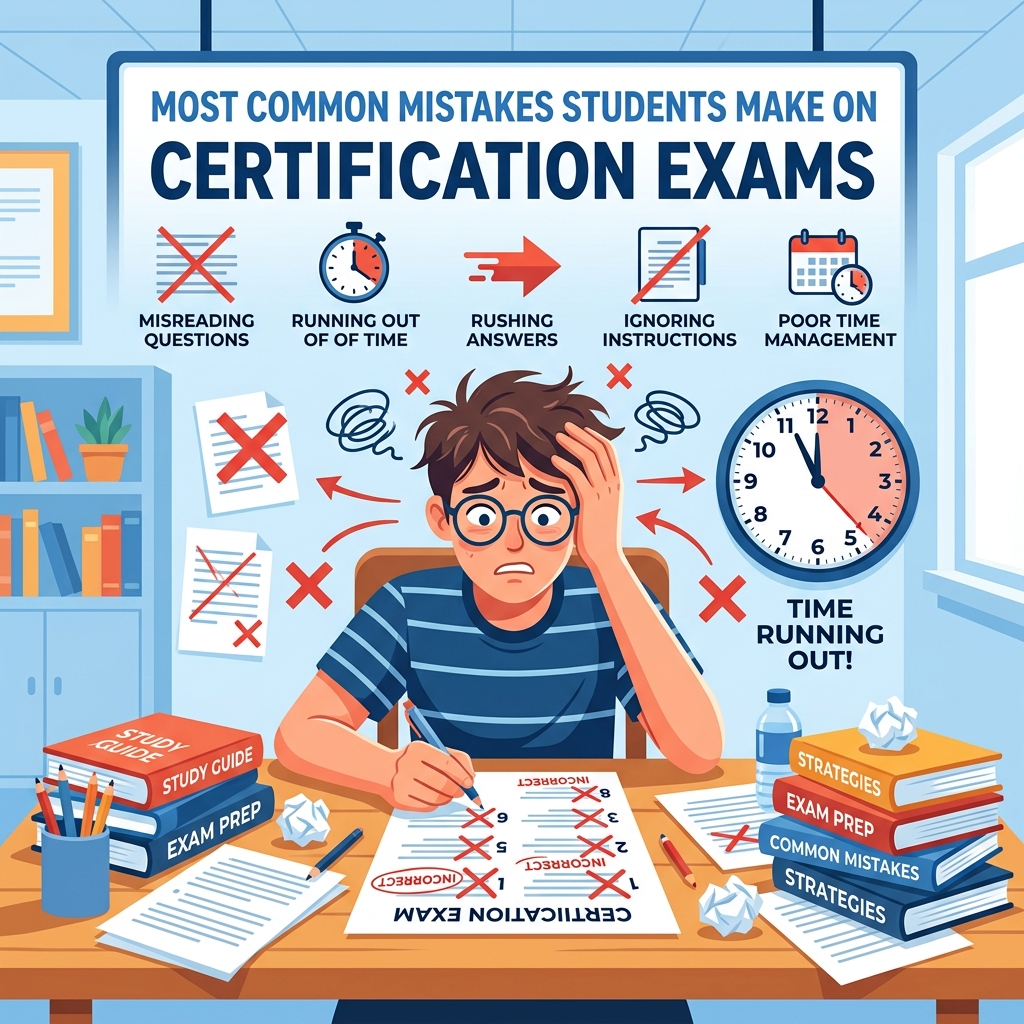
Every year, thousands of certification candidates walk into exam day feeling prepared — and walk out with a failing score. The frustrating truth is that most of these failures are not caused by lack of knowledge. They are caused by the same repeatable, avoidable mistakes that candidates have been making across every certification exam, in every field, for decades.
Understanding these mistakes before you make them is one of the highest-leverage things you can do with your prep time. This guide documents the most damaging patterns — with the research behind them and the specific fixes that actually work.
Overview: The 10 Most Costly Certification Exam Mistakes
| # | Mistake | Impact Level | How Common |
|---|---|---|---|
| 1 | Memorizing definitions instead of understanding application | ud83dudd34 Very High | Extremely Common |
| 2 | Saving practice questions for the end | ud83dudd34 Very High | Very Common |
| 3 | No timed practice sessions | ud83dudfe0 High | Very Common |
| 4 | Changing correct answers at the last minute | ud83dudfe0 High | Common |
| 5 | Ignoring qualifier words in questions | ud83dudd34 Very High | Extremely Common |
| 6 | Studying all topics with equal intensity | ud83dudfe0 High | Very Common |
| 7 | Cramming the night before | ud83dudfe1 Medium | Extremely Common |
| 8 | Poor sleep and physical preparation | ud83dudfe0 High | Common |
| 9 | Not reviewing wrong answers | ud83dudd34 Very High | Very Common |
| 10 | Studying in non-exam conditions | ud83dudfe1 Medium | Common |
Mistake #1: Memorizing Definitions Instead of Understanding Application
This is the single most damaging mistake on any certification exam, and it is also the most widespread. Students drill flashcards, copy definitions from study guides, and feel confident because they can recite terminology fluently. Then the exam presents a scenario-based question, and the memorized definition is completely useless.
Modern certification exams — from the RBT to the PMP to the NCLEX — are deliberately designed to test application, not recall. The exam writers know that definitions can be memorized by anyone. What differentiates qualified practitioners is whether they can recognize the right procedure in a real situation and execute it correctly.
| Memorization-Level Study | Application-Level Study |
|---|---|
| Defining “negative reinforcement” | Identifying negative reinforcement when described in a client scenario |
| Listing types of measurement recording | Choosing which measurement type to use for a specific behavior and context |
| Reciting the steps of DTT | Troubleshooting when DTT is not producing results in a described scenario |
The fix: For every concept you study, immediately create or find a scenario-based question about it. If you cannot answer a question about the concept in context, you do not yet understand it well enough. Techniques like active recall dramatically outperform re-reading — see our guide on best active recall techniques for studying for the full methodology.
Mistake #2: Saving Practice Questions for the End
Many students treat practice exams as a “check” to run after they have finished learning everything. This gets the sequence completely wrong. Practice questions are not just a diagnostic — they are a primary learning tool.
The psychological science here is well established. A landmark study published in Science (Karpicke & Roediger, 2008) found that students who used retrieval practice — answering questions from memory — retained 50% more material after a week than students who spent the same time re-studying. Getting a question wrong is not failure; it is the most efficient form of learning available.
Are you ready for the interview?
Practice interview questions in a real interview-style setting.
The fix: Start answering practice questions from day one of your prep, before you feel ready. Aim for at least 20 practice questions per study session from the beginning, increasing to 30–40 as your exam date approaches. Track which questions you get wrong and review them the same day.
Mistake #3: No Timed Practice Sessions
Doing practice questions at your own pace, with no timer, in a comfortable environment, is valuable — but it does not prepare you for the specific pressure of a real exam. Time pressure changes how your brain works. It narrows attention, increases anxiety, and slows reading speed in ways that are genuinely difficult to predict unless you have experienced them in practice.
| Practice Type | What It Trains | When to Use |
|---|---|---|
| Untimed, open book | Concept understanding, answer rationale | Early prep (weeks 1–4) |
| Untimed, closed book | Recall strength, weak area identification | Mid prep (weeks 3–6) |
| Timed, full exam | Pacing, exam stamina, pressure management | Late prep (weeks 6–8) |
| Timed, 20-question sets | Quick pacing without full-exam fatigue | Throughout prep |
The fix: Run at least 3–4 full-length timed practice exams before your real test date. Treat them identically to the real exam — no pausing, no looking things up mid-session, same time of day if possible. Read our guide on the difference between mock exams and real exams to understand exactly what to simulate.
Mistake #4: Changing Correct Answers at the Last Minute
Research on answer-changing behavior during tests is remarkably consistent across decades of study. A meta-analysis reviewing 33 separate studies found that when students changed answers, 57% of changes went from correct to incorrect, while only 20% went from incorrect to correct. The remaining 23% were correct-to-correct or incorrect-to-incorrect changes.
Your initial answer choice is typically driven by pattern recognition — the accumulated experience of studying and practicing. When you second-guess that choice, you are often responding to test anxiety rather than better reasoning.
The fix: Develop a personal rule and commit to it before exam day: only change an answer if you can articulate a specific, concrete reason. “I feel uncertain” is not a reason. “I re-read the question and noticed it says ‘except'” is a reason. Build this habit during your practice exam sessions so it is automatic by test day.
Mistake #5: Ignoring Qualifier Words in Questions
Certification exams are written with extreme linguistic precision. A single word in the question stem can completely change what the correct answer is. Candidates who skim under pressure miss these qualifiers constantly — and pay for it with incorrect answers on questions they actually knew the content of.
| Qualifier Word | What It Changes | Example Impact |
|---|---|---|
| MOST appropriate | Requires best answer, not just a correct one | Multiple answers may be technically correct; one is more correct |
| FIRST | Asks for priority/sequence | Even if other steps are needed, what happens first? |
| EXCEPT | Inverts the question entirely | You are looking for the one that does NOT fit |
| ALWAYS / NEVER | Absolute rule — rarely true in practice | Usually eliminates options that have exceptions |
| PRIMARY | Main purpose, not secondary benefits | A procedure may have multiple functions; identify the primary one |
The fix: During every practice session, develop the habit of circling or mentally highlighting qualifier words before reading answer choices. This single habit can save you 5–10 questions on a full-length exam — potentially the difference between passing and failing.
Mistake #6: Studying All Topics With Equal Intensity
Free ATS Resume Maker & Analyzer
Create a resume that passes ATS checks and impresses recruiters in seconds.
Most certification exams publish an official content outline or exam blueprint that shows exactly what percentage of questions come from each domain or topic area. Candidates who ignore this document and study everything equally are misallocating their time in ways that directly hurt their scores.
Consider a simple example: if Domain A is 8% of your exam and Domain B is 24%, spending equal time on both means you are under-studying the area that contributes three times more to your score. Multiply this across six domains and you can see how significant the misallocation becomes over an 8-week prep period.
The fix: Download your exam’s official content outline immediately. Build your study schedule around the domain weights, not around equal time allocation. Higher-weight domains deserve more review cycles, more practice questions, and more conceptual depth. Lower-weight domains still need coverage — just proportionally less of it.
Mistake #7: Not Reviewing Wrong Answers
Most candidates look at which questions they got wrong, note the correct answer, and move on. This is the least effective possible use of wrong answers. A wrong answer contains far more learning value than a correct one — but only if you actually extract that value.
The protocol that actually works:
- Identify exactly why you got it wrong. Was it a knowledge gap, a misread question, elimination error, or a time-pressure mistake?
- Understand why the correct answer is correct — not just that it is correct.
- Understand why the distractors are wrong — this prevents confusing them in future similar questions.
- Write the concept in your own words. If you cannot explain it without looking at the answer, you do not fully understand it yet.
- Re-test yourself on the concept 2–3 days later. This spaced retrieval solidifies the learning.
For the science behind spaced review, read our article on spaced repetition explained for exam preparation.
Mistake #8: Cramming the Night Before
This habit is so deeply embedded in student culture that most candidates feel guilty if they are not cramming the night before their exam. The research says this guilt is misplaced. High-volume last-minute review produces marginal, short-lived retention — not the deep recall needed during a 90-minute exam.
What actually happens during sleep is critical for exam performance. Sleep is when memory consolidation occurs — when the brain converts short-term learning into stable long-term memory. Disrupting this process with late-night cramming reduces the availability of the material you have spent weeks learning.
| Night Before Activity | Effect on Exam Performance |
|---|---|
| 3+ hours of intense new material cramming | Interferes with memory consolidation; increases anxiety |
| 1–2 hours of light review of existing notes | Minimal benefit; acceptable if it reduces anxiety |
| 7–8 hours of quality sleep | Strongly positive effect on recall, processing speed, and error detection |
| No studying; full rest and preparation | Optimal for candidates who have completed their prep cycle |
The fix: Finish your meaningful content review at least 48–72 hours before exam day. The night before should be light review of your weak-area notes only — nothing new, no full practice exams. Then get 7–8 hours of sleep. This is not laziness. It is optimization. See our complete guide on how sleep affects exam performance.
Mistake #9: Poor Physical and Morning Preparation
Cognitive performance on exam day is partly physical. Dehydration impairs concentration, reaction time, and working memory. Skipping breakfast reduces blood glucose levels that the brain runs on. Arriving rushed and stressed activates cortisol responses that narrow attention and impair recall.
None of this is soft preparation advice. It is neurophysiology. You have spent weeks building knowledge in your brain — it runs on the same biochemistry as the rest of your body. See our guide on the best foods to eat before an exam and the best morning routine before an important exam.
Mistake #10: Not Simulating Real Exam Conditions
Doing practice questions on your couch with your phone next to you, pausing whenever you want, in a comfortable and familiar environment, does not prepare you for the sensory and cognitive experience of a real testing center. The unfamiliarity of the environment alone has been shown to mildly impair recall due to context-dependent memory effects.
The fix: At least twice before exam day, simulate the full exam environment. Sit at a desk (not a couch). Remove your phone from the room. Set a countdown timer for the full exam duration. Do not pause for anything except necessary breaks. Use a platform like InterviewForge’s mock exam simulator that replicates timed test conditions. The more familiar the exam environment feels before exam day, the less cognitive energy you will spend adjusting to it during the actual test.
Quick Reference: The Mistake Avoidance Checklist
| Checkpoint | Done? |
|---|---|
| Downloaded official exam content outline and weighted study plan | u2610 |
| Doing practice questions from day one of prep | u2610 |
| Reviewing ALL wrong answers with full explanation | u2610 |
| Completed at least 3 full-length timed practice exams | u2610 |
| Practiced in simulated exam conditions (desk, timer, no phone) | u2610 |
| Studying concepts at application level, not just definition level | u2610 |
| Identified qualifier words habit built during practice sessions | u2610 |
| Finished major content review 48+ hours before exam | u2610 |
| Planned for 7–8 hours sleep the night before | u2610 |
| Prepared exam morning logistics (ID, testing center address, breakfast) | u2610 |
Frequently Asked Questions
What is the most common reason people fail certification exams?
The most common reason is studying at the memorization level instead of the application level. Most modern certification exams test whether you can apply knowledge to realistic scenarios, not whether you can recite definitions. Candidates who only memorize terminology without understanding how concepts work in practice consistently underperform expectations.
Should I change my answers if I am unsure during the exam?
Only change an answer if you have a specific, clear reason — such as noticing a qualifier word you missed, or realizing you misread the question. Research shows that 57% of answer changes go from correct to incorrect. In the absence of a concrete reason to change, leave your first answer.
How many practice questions should I do before my certification exam?
Most exam preparation experts recommend completing 300–500 practice questions before a standard certification exam. For higher-stakes exams (NCLEX, bar exam), the number can be significantly higher. The quality of your review of each question matters as much as the volume — see our article on how many practice questions you should do per day.
Is it bad to study the night before an exam?
Light review of existing notes is acceptable and can reduce anxiety. What is harmful is intensive cramming of new material, which interferes with memory consolidation during sleep and increases cognitive fatigue on exam morning. Aim to complete all meaningful content review at least 48 hours before exam day.
Final Word
Most certification exam failures are not failures of intelligence or effort. They are failures of strategy. The ten mistakes outlined here are responsible for a disproportionate share of failing scores — and every single one of them is within your control to avoid.
Study for application, not memorization. Start practice questions immediately. Review every wrong answer thoroughly. Simulate exam conditions. Sleep before your exam. These are not complicated insights — but acting on them consistently, for the full duration of your prep, is exactly what separates candidates who pass on the first attempt from those who do not.

The 4 Functions of Behavior in ABA: A Complete Guide
Master the 4 functions of behavior (SEAT) with the complete ABA guide: definitions, clinical examples, function-based treatment table, functional assessment...

How to Renew Your RBT Certification: Step-by-Step Guide
Step-by-step RBT renewal guide: 4 required components, 90-day timeline, competency assessment requirements, what happens if your credential lapses, and year-round...


What to Do the Day Before and Day of Your Certification Exam
Day-by-day framework for the week before your exam, a specific night-before protocol, hour-by-hour exam morning guide, and in-exam tactics. Research-backed...


RBT Data Collection Methods: A Complete Guide
Complete guide to RBT data collection: continuous vs. discontinuous measurement, all 8 recording methods with tables, new 3rd Edition calculation...


ABA Therapy Techniques Every RBT Should Know
Complete guide to core ABA therapy techniques for RBTs: reinforcement types, DTT, NET, prompting hierarchies, chaining, differential reinforcement, and extinction....


RBT Supervision Requirements: Everything You Need to Know
Complete guide to RBT supervision requirements: the 5% monthly minimum, what qualifies as supervision, documentation standards, annual renewal, and what...

RBT vs. BCBA: What Is the Difference and Which Career Is Right for You?
RBT vs. BCBA: compare education requirements, salary data, scope of practice, and career timelines side by side. Includes 5 comparison...


RBT Practice Questions: How to Use Them Effectively
Research shows practice testing beats all other study methods by 43%. Learn how to use RBT practice questions with a...

The Best Study Methods for Passing Difficult Exams
Science ranks retrieval practice 43% more effective than re-reading. Discover the 7 best study methods for certification exams, with research...

How Long Should You Study for a Certification Exam?
How long should you study for a certification exam? Use our 3-step calculation framework, reference table of 8 certifications, Ebbinghaus...

Most Common Mistakes Students Make on Certification Exams (And How to Avoid Them)
Research shows 57% of answer changes go from correct to wrong. Discover the 10 most damaging certification exam mistakes —...

How to Pass the RBT Exam on Your First Attempt (Complete 2026 Guide)
The RBT exam has a ~68% first-attempt pass rate. Learn the exact 8-week study plan, domain breakdown with weighted tables,...

Top 10 Interview Questions For A Team Leaders
In order to increase your chances of landing a position as a team leader, it is essential to demonstrate your...

Interview Question For A Learning Support Assistant
Fear about possible questions for interviews are normal if you’re seeking a job as a learning support teacher. Remember that...

Top 10 Common Questions Asked In Sainsbury’s Interview
Everything you need to know about Sainsbury’s interview questions is right here. 10 most important question that might asked throughout...

10 Common Questions For Sen Teaching Assistant
When applying for a special needs teaching assistant position, demonstrate the hiring manager that you have the skills and compassion...

15 Questions Samples To Ask At End Of Teaching Assistant Interview
Here are some questions samples, you should ask the interviewer at the end of the teaching assistant interview. 15 Questions...

Interview Questions And Answers For Sales Associates
Your sales associate interview is a chance to sell yourself to the recruiting manager by discussing and demonstrating your interests,...

How To Write A Cover Letter In An Attractive Way?
Attaching a cover letter to your CV is a one-page document that serves the purpose of introducing you to a...

Interview Tips For A Supervisor Job
The interview questions you face for a management or supervisory role could differ from those you face for other positions....

What Are Competency Based Questions? The Ultimate Guide
A competency-based interview will focus on testing your knowledge, abilities, and character traits as they pertain to the position for...

Top 25 Tesco Interview Questions And Answers: Ultimate Preparation Guide
Preparing for a job interview can be a nerve-wracking experience, especially when it comes to a reputable company like Tesco....

10 Best Questions Samples For A Phone Interview
To ensure the applicants they promote to the hiring manager fit their criteria, recruiters typically employ phone interviews as a...

Top Interview Questions & Answers For Care Assistant
You may be wondering how to improve your chances of being hired if you are a personal care professional who...

Sample Interview Questions & Answers For Customer Service
If you’re interested in applying for a career in customer service, it’s important to prepare for your interview. This may...

Top 10 Interview Question For Boots
Boots is a successful pharmacy-led health and beauty business well-known for its dedication to providing excellent customer service and high-quality goods....

10 Common Safeguarding Interview Questions For Teaching Assistant.
You will be questioned on a range of issues when you attend an interview for the teaching assistant position. You...

Top 13 Excel Interview Questions & Answers
The most used spreadsheet program is Microsoft Excel. Every expert working in a big or medium-sized business nowadays uses this...

How To Answer The Question: What Do You Know About Aldi?
When you are getting ready for an interview at Aldi, it is essential to be prepared for certain questions that...

10 Best Answers For “Why Should We Hire You?
No matter the industry or position you’re seeking, some types of questions are sure to come up during a job...

16 Most Important Interview Questions For Teacher
Preparing for a job interview in the field of education? You may feel a mixture of excitement and anxiety. The...

Top 11 Retail Assistant Interview Questions
An interview provides you with the chance to showcase your abilities, personality, and work ethic to a potential employer while...

Top 10 Administration Assistant Interview Questions
Administrative professionals are in high demand. Using these abilities has actually been one of the five most sought-after job categories...

Top 10 Morrison’s Interview Questions And Answers
The supermarket chain Morrisons is one of the most successful in the UK and is well-known for its dedication to...

What Makes A Good Sen Teaching Assistant?
Students who have difficulty learning are provided with extra learning opportunities by a special educational needs (SEN) teaching assistant, who...

Best Answers To “Where Do You See Yourself As A Teacher In 5 Years?”
When you decide to pursue a career in education, you are not just making a professional decision; you are committing...

Top 10 Safeguarding Interview Questions For Support Workers
Those who serve as support workers are vital in ensuring that at-risk youth, families, and the elderly can live fulfilling,...

10 Common Interview Questions For McDonald’s
If you work for the most profitable business in history, flipping burgers is definitely not a dirty job. Fast food...

10 Important Interview Questions For Eyfs Teaching Assistant
Proven strategies and insightful responses to 11 key questions for seamless integration into the world of play-based learning and individualized....

10 Common Questions And Answers For Childcare Interview
Working with kids is satisfying and hard. Before you can teach your kids, you must pass the recruiting procedure, which...

Tips To Answering Behavioral Interview Questions
Interviewers can ask about your prior actions and reactions to certain scenarios to get a feel for how you might...

Best Personal Statement Samples For Civil Service Job
An accompanying personal statement may be necessary when applying for a position in the public sector. You may learn more...

Top 10 Common Safeguarding Interview Questions Of Staff
Many industries prioritize safeguarding, notably those that care for staff, the elderly, and the disabled. This field requires professionals who...

Top 10 Interview Tips For Teacher
When you are applying for jobs at a variety of educational institutions, the interview that you have with the potential...

Top 15 Reasons To Leave A Job
Leaving one’s work was not only unusual but also considered to be something of a social faux pas. Why, after...


How Does an Assistant for Lawyers Get Hired by a Law Firm?
The many career opportunities offered by law make this profession one of the most sought-after and popular in the worldwide...


How to Conduct a SWOT Analysis for Career Growth
Introduction A SWOT analysis is a simple cut powerful tool that helps to understand these strengths, weaknesses, opportunities and threats...


How to Stay Motivated During Long Job Searches
Introduction The most challenging and frustrating process is looking for a job especially when it takes longer than expected to...


How to Handle Situational Questions Effectively
Introduction Situational questions refer to tests that are taken to test the ability of a candidate to think critically, solve...


Tips for Researching Hiring Managers on LinkedIn
Introduction In today’s competitive and advanced top market it is important to know about how to reset hiring managers on...


The Role of Job Shadowing in Interview Prep
Introduction Job interviews can be extremely stressful especially when someone is entering a new field or applying for a job...


How to Create a Job Application Tracker
Introduction It can be stressful to look for a job especially when someone wants to apply in multiple positions. By...


Top Courses for Enhancing Remote Work Skills
Introduction Remote works are now considered as a major part of today’s professional world. They provide people with flexible schedules,...


How to Master Professional Email Writing Through Online Classes
Introduction In today’s digital and fast paced world, professional email writing is considered as an important skill. If someone is...


Certifications in Workplace Diversity and Inclusion
Introduction In today’s fast paced and digital world there are work places that are becoming more diverse than they ever...


Top Programs for Building Financial Literacy Skills
Introduction Financial literacy is an important life skill that helps the individuals to manage their money and to make informed...


Certifications for Advanced Team Collaboration Skills
Introduction It is important to have teamwork in today’s workplace because it has to build the companies. There are companies...


Tips for Reviewing Company Financials Before Interviews
Introduction When we candidates are preparing for the job interview they only focus on their resume, possible interview questions and...

How to Build a STAR Story Bank for Interviews
Introduction Job interviews can be quite stressful to manage especially when the employers ask behaviour in questions like tell me...


How to Use Nonverbal Cues Effectively During Interviews
Introduction Interviews are considered as an opportunity to present yourself in front of the employers. They are not only about...

Ultimate Guidance: How To Give A Great Job Interview Presentation?
During an interview, you can be requested to deliver a presentation on a subject that is pertinent to the position....

How To Write A Job Application Letter Efficiently?
At the same time that the world is becoming a better place, competition for jobs is heating up. Finding a...

Top 10 Ways To Make A Great LinkedIn Profile
You should have an interesting LinkedIn profile at every point in your job hunt. LinkedIn is easily the biggest professional...

Top 10 Questions And Answers For A SQL Interview
The following is a list of the most prominent and helpful SQL interview questions and answers for applicants who are...

Top Teaching Assistance Online Courses
Could you see yourself working as an assistant in a classroom? The importance of teaching assistants has increased significantly in...

Is Being A Teaching Assistant Worth It?
Teaching assistants (TAs) play a vital role in the ever-changing field of education. They assist teachers significantly and substantially contribute to...

Top 5 Online Courses For Excel
FOAt the most basic level, Microsoft Excel is a spreadsheet tool used to gather, analyse, and display qualitative and quantitative...

Top Reasons Why Safeguarding Is Important
If your company does business with or is otherwise frequently connected to children and/or people who are vulnerable, one of...

How To Become A Teaching Assistant?
Do you want to become a teaching assistant but don’t know where to begin? A teaching assistant in the classroom...

Most Common Questions To Ask At End Of Teaching Assistant Interview
The secret to acing an interview is preparation, which includes studying up on the organization and the most typical questions...

Top Training Courses For A Sen Teaching Assistant
The key problem with effectively supporting students with Special Educational Needs (SEN) in educational settings is one that the SEN...

How to Answer “Why Do You Want To Be A Teacher?”
Employers may use this question to determine whether or not you are a committed teaching professional by making use of...

What Makes A Good Teaching Assistant?
A classroom doesn’t work without a teaching assistant. By ensuring that every student has access to the resources they need...

Top 15 Interview Questions For Nursery Assistant
You may be well-prepared for the interview by reading the questions ahead of time, but your greatest chance of landing...


Is It Possible To Become A Teacher Assistant Without Any Experience?
When working in an educational environment, teaching assistants and aids collaborate with the primary instructors. In addition to providing assistance...

Which Skills Are Needed To Work In The Nursery?
Beginning a career at a nursery may be quite satisfying since it provides the opportunity to directly influence the early...

Top 15 Qualities Of A Good Teacher
The most effective teachers, whether they work in traditional Classroom settings or online, have a set of traits that make...


Why It’s Important to Modernize Your Skills and Keep Up With New Health Tech?
Healthcare is evolving at an unprecedented pace, driven by technological advancements and innovative treatment methods. For professionals in the medical...


Clean Audit: Building a Culture of Year-Round Compliance
For many organizations, the annual audit feels like a high-stakes event that demands intense preparation in a short window of...


Marketing Playbook: Evergreen Tactics That Actually Drive ROI
Marketing trends come and go, but some strategies consistently deliver results regardless of industry shifts. These evergreen tactics form the...
-

 Interview Preps2 years ago
20 Caregiver Interview Questions And Answers
-
 Interview Preps1 year ago
Why Should We Hire You As A Teacher? Practical Answers
-

 Interview Preps1 year ago
Top 35 Must Know Greggs Interview Questions & Expert Answers!
-
 Interview Preps1 year ago
The Most Common Questions For Aldi Video Interview
-
Interview Preps3 months ago
What Are Competency Based Questions? The Ultimate Guide