
Articles
RBT vs. BCBA: What Is the Difference and Which Career Is Right for You?
RBT vs. BCBA: compare education requirements, salary data, scope of practice, and career timelines side by side. Includes 5 comparison tables and a decision guide for every career stage.

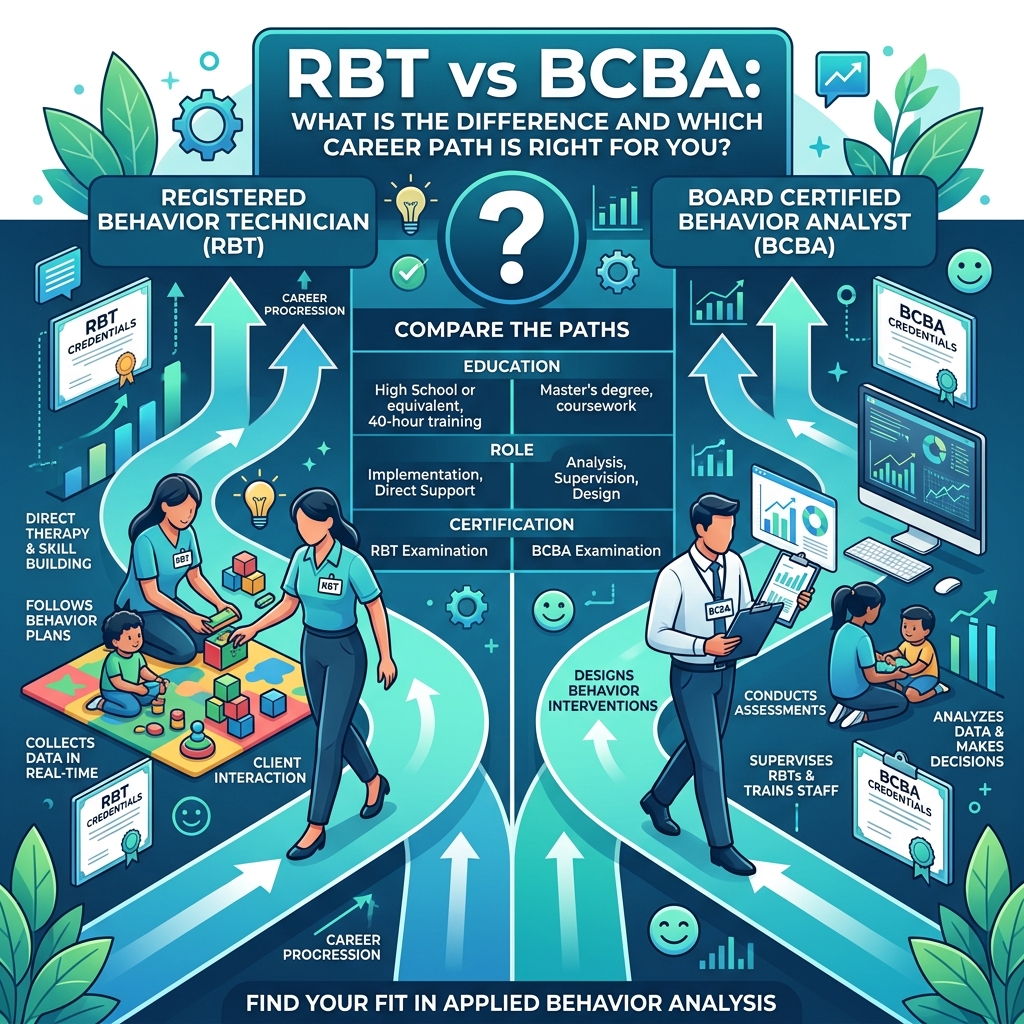
When most people first encounter the world of Applied Behavior Analysis, two credential names appear almost immediately: RBT and BCBA. Both work in ABA therapy. Both hold BACB credentials. But beyond those surface similarities, the roles are fundamentally different – in scope of practice, level of autonomy, required education, earning potential, and career trajectory. Understanding these differences clearly is essential whether you are choosing which credential to pursue or trying to map a long-term career path in behavioral health.
Quick Comparison: RBT vs. BCBA at a Glance
| Credential | RBT | BCBA |
|---|---|---|
| Full Name | Registered Behavior Technician | Board Certified Behavior Analyst |
| Education Required | High school diploma or equivalent | Master’s degree in behavior analysis or related field |
| Experience Required | 40 hours supervised practical experience | Supervised fieldwork: 2,000 hours (intensive) or 1,500 hours (concentrated) |
| Exam | 85 questions, 90 minutes, computer-based at Pearson VUE | 185 questions, 4.5 hours, computer-based at Pearson VUE |
| Exam Fee | $45 | $245 |
| Scope of Practice | Implements behavior plans under direct BCBA supervision | Designs, oversees, and modifies behavior intervention plans; supervises RBTs |
| Autonomy Level | Works under close supervision; does not independently design programs | Functions independently; responsible for clinical decision-making |
| Average Annual Salary (US) | $35,000–$55,000 | $65,000–$95,000+ |
| Credential Renewal | Annual renewal with ongoing supervision verification | Every 2 years (32 CE hours required) |
| Time to Credential | 6–10 weeks (after meeting prerequisites) | 2–4 years (master’s degree + supervised hours + exam) |
The Role of an RBT: What You Actually Do Day to Day
Registered Behavior Technicians are the frontline practitioners of ABA therapy. They work directly with clients – most commonly children diagnosed with autism spectrum disorder – implementing the behavior intervention programs that BCBAs design and supervise. The work is hands-on, relationship-driven, and directly impactful.
A typical RBT session involves:
- Running discrete trial teaching (DTT) programs targeting communication, self-care, or academic skills
- Collecting data on client behavior (frequency, duration, latency) throughout the session
- Implementing behavior reduction protocols as designed by the supervising BCBA
- Practicing naturalistic teaching during play and daily activities
- Documenting session notes and updating graphs
- Communicating observations to the supervising BCBA for program review
RBTs do not independently design programs, interpret assessment results, or modify behavior plans without supervisor input. This is an important boundary – not because RBTs are not skilled, but because the BACB ethics code is designed to ensure that clinical decisions requiring advanced training are always made by credentialed supervisors.
The Role of a BCBA: What Board Certified Analysts Actually Do
Board Certified Behavior Analysts are the clinical architects of ABA programs. They assess clients, design individualized behavior intervention plans, analyze data to evaluate program effectiveness, modify procedures based on outcomes, and supervise RBTs and other paraprofessionals who implement those programs.
A typical BCBA caseload involves:
- Conducting functional behavior assessments (FBA) and preference assessments
- Writing and revising behavior intervention plans based on assessment data
- Reviewing client progress graphs and making data-driven program modifications
- Supervising RBTs – observing sessions, providing performance feedback, and signing off on monthly supervisory requirements
- Collaborating with school teams, families, physicians, and other professionals
- Maintaining ethical compliance with BACB professional standards
BCBAs carry full professional responsibility for the clinical quality of the programs they design and the staff they supervise. This greater accountability is reflected in the significantly higher education and experience requirements for the credential.
Are you ready for the interview?
Practice interview questions in a real interview-style setting.
Education and Eligibility Requirements: A Detailed Comparison
| Requirement | RBT Details | BCBA Details |
|---|---|---|
| Minimum Education | High school diploma or GED | Master’s degree in behavior analysis, psychology, education, or related field with BACB-approved coursework sequence |
| Age Requirement | Must be 18 years old | No specific age requirement beyond degree completion |
| Training Hours | 40 hours of structured training covering the RBT TCO domains | Supervised fieldwork: 2,000 hours (intensive supervised) OR 1,500 hours (concentrated supervised) |
| Supervision Requirement | Must be supervised by a BCBA/BCaBA for at least 5% of monthly direct service hours; ongoing throughout career | Must accumulate supervised hours under a BCBA with specific distribution requirements during training period |
| Coursework | None required beyond training hours | Verified Course Sequence (VCS) covering 315 hours of graduate-level behavior analysis content |
| Background Check | Required at initial certification and renewal | Required at initial certification and renewal |
Salary and Career Outlook: What the Data Shows
The demand for ABA professionals has grown substantially over the past decade, driven by increased autism diagnoses, expanded insurance coverage mandates for ABA therapy in most US states, and growing use of behavior analysis in schools, corporate settings, and sports performance. Here is what current salary data shows for both credentials:
| Factor | RBT Salary Range | BCBA Salary Range |
|---|---|---|
| National Median (US) | $40,000–$48,000 | $72,000–$85,000 |
| Entry Level | $32,000–$38,000 | $60,000–$70,000 |
| Experienced (5+ years) | $45,000–$58,000 | $85,000–$110,000+ |
| High Cost-of-Living States (CA, NY, MA) | $48,000–$65,000 | $90,000–$130,000+ |
| Clinical Director / Senior BCBA | N/A (role not applicable) | $100,000–$150,000+ |
| Job Growth Outlook | Strong; driven by ABA therapy expansion | Very strong; BCBA shortage in many regions |
The salary differential between RBT and BCBA is substantial – typically $25,000–$40,000 per year for comparable experience levels. However, the path to BCBA requires a significant investment of time (2–4 additional years) and money (graduate tuition). Many professionals begin as RBTs specifically to gain paid experience while pursuing their master’s degree – a financially smart approach since RBT work experience counts toward BCBA supervised fieldwork hours in some cases.
Using the RBT as a Stepping Stone to BCBA
The majority of practicing BCBAs began their careers as RBTs or behavior technicians before pursuing advanced credentials. This pathway has several significant advantages:
- Financial sustainability during graduate school. RBT positions in clinical settings often offer full-time employment with benefits, allowing candidates to fund their graduate education while gaining required experience.
- Applied understanding of theoretical concepts. Candidates who have worked as RBTs before studying behavior analysis at the graduate level consistently report that their fieldwork experience makes abstract concepts far more concrete and applicable.
- Supervised hours accumulation. Working as an RBT under a BCBA supervisor means you may be simultaneously accumulating supervised hours toward your BCBA eligibility, depending on your employer’s structure and your supervisor’s willingness to supervise toward BCBA hours.
- Professional network development. The relationships built during RBT work – with supervisors, colleagues, and clients – often directly support the supervised hours and mentorship needed for BCBA candidacy.
Which Path Is Right for You?
| Your Situation | Recommended Starting Path | Reasoning |
|---|---|---|
| No college degree; want to work in ABA now | Start with RBT | RBT requires only a high school diploma; credential achievable in weeks; immediate employment entry point |
| Bachelor’s degree; interested in ABA long-term | RBT now, pursue BCBA graduate program | RBT provides paid experience and income during the 2–3 years needed for a master’s degree |
| Currently in a graduate ABA program | Get RBT certified immediately | Working as an RBT while in grad school builds practical skills and may count toward supervised hours |
| Already a BCBA seeking renewal content | Not applicable – pursue BCBA CEUs | CEU options available through BACB-approved providers |
| Career change from another field; master’s degree already held | Verify degree relevance, then pursue RBT + BCBA simultaneously | If degree is in psychology, education, or related field, may qualify for VCS coursework; RBT experience runs parallel |
Frequently Asked Questions
Can an RBT work without a BCBA supervisor present?
RBTs can work directly with clients without a BCBA physically present during every session – in fact, most RBTs work independently for the majority of their sessions. However, they must receive regular supervision from a BCBA or BCaBA (at least 5% of their monthly direct service hours), and they must have access to supervisory support for clinical questions that arise. The key distinction is that RBTs cannot independently make clinical decisions – those must be escalated to and handled by the supervising BCBA.
How long does it take to go from RBT to BCBA?
The full pathway from RBT to BCBA typically takes 3–5 years. This includes completing a master’s degree program (2–3 years), accumulating the required supervised fieldwork hours (which can run concurrently with graduate school), and passing the BCBA examination. The timeline can be compressed to approximately 2.5 years for candidates who pursue accelerated graduate programs and accumulate supervised hours efficiently during their degree.
Is it worth getting an RBT if I plan to become a BCBA?
Yes – for almost all candidates. Getting your RBT certification provides immediate employability in ABA settings, allows you to earn income while pursuing your graduate degree, builds practical experience that directly strengthens your BCBA knowledge base, and may help you accumulate supervised fieldwork hours concurrently. The RBT certification takes only 6–10 weeks to prepare for and costs $45 to sit for the exam – it is a low-cost, high-value career entry point regardless of your long-term goals. For the full preparation guide, see our article on how to pass the RBT exam on your first attempt.
What is the difference between BCaBA and BCBA?
The BCaBA (Board Certified Assistant Behavior Analyst) is a mid-level credential between RBT and BCBA. It requires a bachelor’s degree, a BACB-approved coursework sequence, and supervised fieldwork hours, but does not require a master’s degree. BCaBAs can design and implement behavior programs but must do so under the supervision of a BCBA. The credential is less commonly required by employers than either the RBT or BCBA, and many candidates in the field proceed directly from RBT to BCBA without obtaining the BCaBA credential.
The Bottom Line
The RBT and BCBA credentials represent two distinct roles within the same field, not simply different seniority levels of the same job. RBTs are skilled practitioners who deliver therapy directly; BCBAs are clinical professionals who design, supervise, and continuously improve the programs that RBTs implement.
Free ATS Resume Maker & Analyzer
Create a resume that passes ATS checks and impresses recruiters in seconds.
If you are early in your ABA career, the RBT is the fastest and most accessible entry point. If you have a long-term commitment to behavior analysis as a profession, the BCBA pathway – ideally starting with the RBT – offers significantly greater clinical autonomy, earning potential, and career ceiling. The two credentials are not in competition; they are designed to work in partnership, and most BCBAs will tell you that their time as RBTs was the most formative period of their clinical development.

The 4 Functions of Behavior in ABA: A Complete Guide
Master the 4 functions of behavior (SEAT) with the complete ABA guide: definitions, clinical examples, function-based treatment table, functional assessment...

How to Renew Your RBT Certification: Step-by-Step Guide
Step-by-step RBT renewal guide: 4 required components, 90-day timeline, competency assessment requirements, what happens if your credential lapses, and year-round...


What to Do the Day Before and Day of Your Certification Exam
Day-by-day framework for the week before your exam, a specific night-before protocol, hour-by-hour exam morning guide, and in-exam tactics. Research-backed...


RBT Data Collection Methods: A Complete Guide
Complete guide to RBT data collection: continuous vs. discontinuous measurement, all 8 recording methods with tables, new 3rd Edition calculation...


ABA Therapy Techniques Every RBT Should Know
Complete guide to core ABA therapy techniques for RBTs: reinforcement types, DTT, NET, prompting hierarchies, chaining, differential reinforcement, and extinction....


RBT Supervision Requirements: Everything You Need to Know
Complete guide to RBT supervision requirements: the 5% monthly minimum, what qualifies as supervision, documentation standards, annual renewal, and what...

RBT vs. BCBA: What Is the Difference and Which Career Is Right for You?
RBT vs. BCBA: compare education requirements, salary data, scope of practice, and career timelines side by side. Includes 5 comparison...


RBT Practice Questions: How to Use Them Effectively
Research shows practice testing beats all other study methods by 43%. Learn how to use RBT practice questions with a...

The Best Study Methods for Passing Difficult Exams
Science ranks retrieval practice 43% more effective than re-reading. Discover the 7 best study methods for certification exams, with research...


How Long Should You Study for a Certification Exam?
How long should you study for a certification exam? Use our 3-step calculation framework, reference table of 8 certifications, Ebbinghaus...

Most Common Mistakes Students Make on Certification Exams (And How to Avoid Them)
Research shows 57% of answer changes go from correct to wrong. Discover the 10 most damaging certification exam mistakes —...

How to Pass the RBT Exam on Your First Attempt (Complete 2026 Guide)
The RBT exam has a ~68% first-attempt pass rate. Learn the exact 8-week study plan, domain breakdown with weighted tables,...

Top 10 Interview Questions For A Team Leaders
In order to increase your chances of landing a position as a team leader, it is essential to demonstrate your...

Interview Question For A Learning Support Assistant
Fear about possible questions for interviews are normal if you’re seeking a job as a learning support teacher. Remember that...

Top 10 Common Questions Asked In Sainsbury’s Interview
Everything you need to know about Sainsbury’s interview questions is right here. 10 most important question that might asked throughout...

10 Common Questions For Sen Teaching Assistant
When applying for a special needs teaching assistant position, demonstrate the hiring manager that you have the skills and compassion...

15 Questions Samples To Ask At End Of Teaching Assistant Interview
Here are some questions samples, you should ask the interviewer at the end of the teaching assistant interview. 15 Questions...

Interview Questions And Answers For Sales Associates
Your sales associate interview is a chance to sell yourself to the recruiting manager by discussing and demonstrating your interests,...

How To Write A Cover Letter In An Attractive Way?
Attaching a cover letter to your CV is a one-page document that serves the purpose of introducing you to a...

Interview Tips For A Supervisor Job
The interview questions you face for a management or supervisory role could differ from those you face for other positions....

What Are Competency Based Questions? The Ultimate Guide
A competency-based interview will focus on testing your knowledge, abilities, and character traits as they pertain to the position for...

Top 25 Tesco Interview Questions And Answers: Ultimate Preparation Guide
Preparing for a job interview can be a nerve-wracking experience, especially when it comes to a reputable company like Tesco....

10 Best Questions Samples For A Phone Interview
To ensure the applicants they promote to the hiring manager fit their criteria, recruiters typically employ phone interviews as a...

Top Interview Questions & Answers For Care Assistant
You may be wondering how to improve your chances of being hired if you are a personal care professional who...

Sample Interview Questions & Answers For Customer Service
If you’re interested in applying for a career in customer service, it’s important to prepare for your interview. This may...

Top 10 Interview Question For Boots
Boots is a successful pharmacy-led health and beauty business well-known for its dedication to providing excellent customer service and high-quality goods....

10 Common Safeguarding Interview Questions For Teaching Assistant.
You will be questioned on a range of issues when you attend an interview for the teaching assistant position. You...

Top 13 Excel Interview Questions & Answers
The most used spreadsheet program is Microsoft Excel. Every expert working in a big or medium-sized business nowadays uses this...

How To Answer The Question: What Do You Know About Aldi?
When you are getting ready for an interview at Aldi, it is essential to be prepared for certain questions that...

10 Best Answers For “Why Should We Hire You?
No matter the industry or position you’re seeking, some types of questions are sure to come up during a job...

16 Most Important Interview Questions For Teacher
Preparing for a job interview in the field of education? You may feel a mixture of excitement and anxiety. The...

Top 11 Retail Assistant Interview Questions
An interview provides you with the chance to showcase your abilities, personality, and work ethic to a potential employer while...

Top 10 Administration Assistant Interview Questions
Administrative professionals are in high demand. Using these abilities has actually been one of the five most sought-after job categories...

Top 10 Morrison’s Interview Questions And Answers
The supermarket chain Morrisons is one of the most successful in the UK and is well-known for its dedication to...

What Makes A Good Sen Teaching Assistant?
Students who have difficulty learning are provided with extra learning opportunities by a special educational needs (SEN) teaching assistant, who...

Best Answers To “Where Do You See Yourself As A Teacher In 5 Years?”
When you decide to pursue a career in education, you are not just making a professional decision; you are committing...

Top 10 Safeguarding Interview Questions For Support Workers
Those who serve as support workers are vital in ensuring that at-risk youth, families, and the elderly can live fulfilling,...

10 Common Interview Questions For McDonald’s
If you work for the most profitable business in history, flipping burgers is definitely not a dirty job. Fast food...

10 Important Interview Questions For Eyfs Teaching Assistant
Proven strategies and insightful responses to 11 key questions for seamless integration into the world of play-based learning and individualized....

10 Common Questions And Answers For Childcare Interview
Working with kids is satisfying and hard. Before you can teach your kids, you must pass the recruiting procedure, which...

Tips To Answering Behavioral Interview Questions
Interviewers can ask about your prior actions and reactions to certain scenarios to get a feel for how you might...

Best Personal Statement Samples For Civil Service Job
An accompanying personal statement may be necessary when applying for a position in the public sector. You may learn more...

Top 10 Common Safeguarding Interview Questions Of Staff
Many industries prioritize safeguarding, notably those that care for staff, the elderly, and the disabled. This field requires professionals who...

Top 10 Interview Tips For Teacher
When you are applying for jobs at a variety of educational institutions, the interview that you have with the potential...

Top 15 Reasons To Leave A Job
Leaving one’s work was not only unusual but also considered to be something of a social faux pas. Why, after...


How Does an Assistant for Lawyers Get Hired by a Law Firm?
The many career opportunities offered by law make this profession one of the most sought-after and popular in the worldwide...


How to Conduct a SWOT Analysis for Career Growth
Introduction A SWOT analysis is a simple cut powerful tool that helps to understand these strengths, weaknesses, opportunities and threats...


How to Stay Motivated During Long Job Searches
Introduction The most challenging and frustrating process is looking for a job especially when it takes longer than expected to...


How to Handle Situational Questions Effectively
Introduction Situational questions refer to tests that are taken to test the ability of a candidate to think critically, solve...


Tips for Researching Hiring Managers on LinkedIn
Introduction In today’s competitive and advanced top market it is important to know about how to reset hiring managers on...


The Role of Job Shadowing in Interview Prep
Introduction Job interviews can be extremely stressful especially when someone is entering a new field or applying for a job...


How to Create a Job Application Tracker
Introduction It can be stressful to look for a job especially when someone wants to apply in multiple positions. By...


Top Courses for Enhancing Remote Work Skills
Introduction Remote works are now considered as a major part of today’s professional world. They provide people with flexible schedules,...


How to Master Professional Email Writing Through Online Classes
Introduction In today’s digital and fast paced world, professional email writing is considered as an important skill. If someone is...


Certifications in Workplace Diversity and Inclusion
Introduction In today’s fast paced and digital world there are work places that are becoming more diverse than they ever...


Top Programs for Building Financial Literacy Skills
Introduction Financial literacy is an important life skill that helps the individuals to manage their money and to make informed...


Certifications for Advanced Team Collaboration Skills
Introduction It is important to have teamwork in today’s workplace because it has to build the companies. There are companies...


Tips for Reviewing Company Financials Before Interviews
Introduction When we candidates are preparing for the job interview they only focus on their resume, possible interview questions and...

How to Build a STAR Story Bank for Interviews
Introduction Job interviews can be quite stressful to manage especially when the employers ask behaviour in questions like tell me...


How to Use Nonverbal Cues Effectively During Interviews
Introduction Interviews are considered as an opportunity to present yourself in front of the employers. They are not only about...

Ultimate Guidance: How To Give A Great Job Interview Presentation?
During an interview, you can be requested to deliver a presentation on a subject that is pertinent to the position....

How To Write A Job Application Letter Efficiently?
At the same time that the world is becoming a better place, competition for jobs is heating up. Finding a...

Top 10 Ways To Make A Great LinkedIn Profile
You should have an interesting LinkedIn profile at every point in your job hunt. LinkedIn is easily the biggest professional...

Top 10 Questions And Answers For A SQL Interview
The following is a list of the most prominent and helpful SQL interview questions and answers for applicants who are...

Top Teaching Assistance Online Courses
Could you see yourself working as an assistant in a classroom? The importance of teaching assistants has increased significantly in...

Is Being A Teaching Assistant Worth It?
Teaching assistants (TAs) play a vital role in the ever-changing field of education. They assist teachers significantly and substantially contribute to...

Top 5 Online Courses For Excel
FOAt the most basic level, Microsoft Excel is a spreadsheet tool used to gather, analyse, and display qualitative and quantitative...

Top Reasons Why Safeguarding Is Important
If your company does business with or is otherwise frequently connected to children and/or people who are vulnerable, one of...

How To Become A Teaching Assistant?
Do you want to become a teaching assistant but don’t know where to begin? A teaching assistant in the classroom...

Most Common Questions To Ask At End Of Teaching Assistant Interview
The secret to acing an interview is preparation, which includes studying up on the organization and the most typical questions...

Top Training Courses For A Sen Teaching Assistant
The key problem with effectively supporting students with Special Educational Needs (SEN) in educational settings is one that the SEN...

How to Answer “Why Do You Want To Be A Teacher?”
Employers may use this question to determine whether or not you are a committed teaching professional by making use of...

What Makes A Good Teaching Assistant?
A classroom doesn’t work without a teaching assistant. By ensuring that every student has access to the resources they need...

Top 15 Interview Questions For Nursery Assistant
You may be well-prepared for the interview by reading the questions ahead of time, but your greatest chance of landing...


Is It Possible To Become A Teacher Assistant Without Any Experience?
When working in an educational environment, teaching assistants and aids collaborate with the primary instructors. In addition to providing assistance...

Which Skills Are Needed To Work In The Nursery?
Beginning a career at a nursery may be quite satisfying since it provides the opportunity to directly influence the early...

Top 15 Qualities Of A Good Teacher
The most effective teachers, whether they work in traditional Classroom settings or online, have a set of traits that make...


Why It’s Important to Modernize Your Skills and Keep Up With New Health Tech?
Healthcare is evolving at an unprecedented pace, driven by technological advancements and innovative treatment methods. For professionals in the medical...


Clean Audit: Building a Culture of Year-Round Compliance
For many organizations, the annual audit feels like a high-stakes event that demands intense preparation in a short window of...


Marketing Playbook: Evergreen Tactics That Actually Drive ROI
Marketing trends come and go, but some strategies consistently deliver results regardless of industry shifts. These evergreen tactics form the...
-

 Interview Preps2 years ago
20 Caregiver Interview Questions And Answers
-
 Interview Preps1 year ago
Why Should We Hire You As A Teacher? Practical Answers
-

 Interview Preps1 year ago
Top 35 Must Know Greggs Interview Questions & Expert Answers!
-
 Interview Preps1 year ago
The Most Common Questions For Aldi Video Interview
-
Interview Preps2 months ago
What Are Competency Based Questions? The Ultimate Guide